
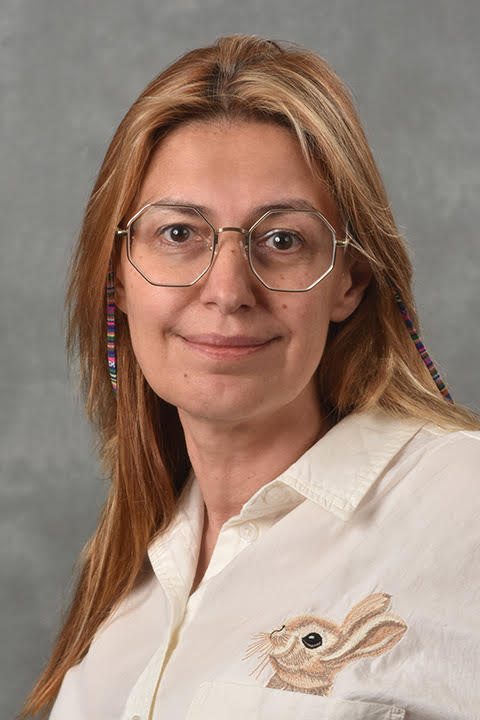
Kate Pechenkina serves as SUNY Oswego's Provost and Vice President for Academic Affairs, a role she assumed in summer 2026. She came to Oswego from Queens College of the City University of New York, where she served as Dean of Faculty in the School of Social Sciences beginning in 2020. Prior to her service as dean, she chaired the Anthropology Department at Queens College.
A Professor of Anthropology, Kate studies how diet, activity, and pathogens shaped the health of early people, drawing on stable isotope analysis and bone biology; she conducts her fieldwork primarily in north-central China, where her research on skeletal remains spans communities ranging from the Neolithic farming villages to the dynasties of early China.
Kate earned an undergraduate degree in Biology from Moscow State University and a Doctor of Philosophy in Anthropology from the University of Missouri.
Education
- University of Missouri-Columbia, USA Doctorate of Philosophy in Anthropology, June 2002
Dissertation: “Diet and Health Changes among the Millet Growing Farmers in Early China.” - Moscow State University, Russia Bachelor of Science in Biology, May 1994
Research Interests
- paleopathology, stable isotope analysis, paleodiet, bone biology, early China
Publications
- Berger E., Pechenkina K. 2024. Trends in American and global bioarchaeology. Trends in World Archaeology Volume 3. Shanghai Ancient Books Publishing House. Pp 3-14. ISBN: 978-7-5732-1325-9. 2.
- Yawei Zhou, Guoshuai Gao, Xiangyu Zhang, Bo Gao, Chenggang Duan, Hong Zhu, Aida R. Barbera, Siân Halcrow, Kate Pechenkina (corresponding). 2022. Identifying treponemal disease in early East Asia. American Journal of Biological Anthropology. 27. 3.
- Halcrow S., Miller MJ, Pechenkina K, Dong Yu, Fan Wenquan. 2021. The Bioarchaeology of Infant Feeding. In The Routledge Handbook of Anthropology and Reproduction, editors Cecília Tomori and Sallie Han. ISBN 9780367278366
Courses Taught
- Undergraduate and graduate level classes on the following topics: Biological Anthropology, Human Genetics and Biological Variation, Human Skeletal Anatomy, Human Health and Disease, Skeletal Analysis, Anthropological Genomics