
Campus Technology Services

Campus Technology Services (CTS) is an integrated service organization, delivering a broad set of infrastructure, applications and services that are vital to the operation and mission of the University.

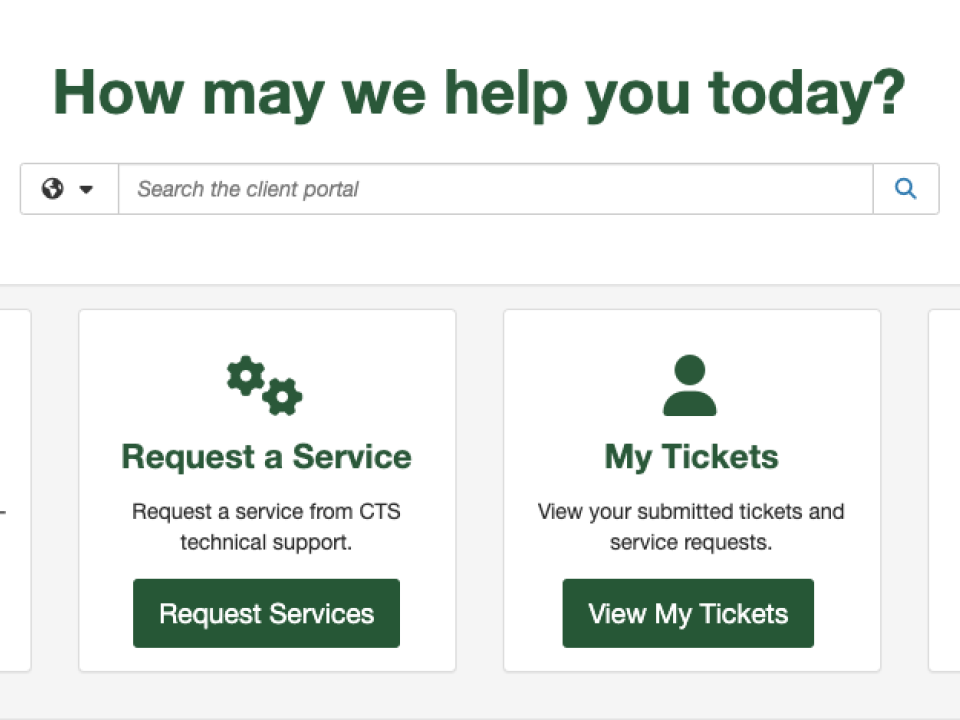
Service catalog homepage, showing the options request a service and my tickets

Have a technology question? Our user-friendly self-service site empowers the campus community to independently request services, track progress, and find solutions. Whether it's setting up multi-factor authentication, accessing classes and class materials, or troubleshooting, it's all just a click away.

Get Help

Announcements and Articles

Recent QR Code Phishing Email April 23, 2026

At approximately 7:46 p.m., April 22, a phishing scam circulated throughout the campus community imitating SUNY Oswego’s refund partner Bankmobile. The following are characteristics of the email:


  • It had the subject line: “Oswego information canvas.” 
  • The sender identified as “Bankmobile IT” with a non-official “@gmail.com” email domain name.
  • It contained a QR code within an image containing the text “SUNY Oswego State University of New York at Oswego” in the background.
  • The image contained foreground text that states “Oswego Student Refund Allocation for Spring.”


If you received one of these emails, please report it as a phish in Gmail and delete it. If you scanned the QR code link and your personal details were entered into a form, please change your password immediately and contact CTS. If you entered any banking details into the form, please contact your bank to review the situation with them.

How to stay safe

  • Check the sender: Official campus emails regarding your SUNY Oswego account always end in @oswego.edu. Click the down arrow next to the sender's name to reveal the full email address.
  • Show caution with QR Codes: QR codes offer convenient mobile access to links, but can easily be designed to lead to malicious websites or trigger malicious software installations. Always question if a QR code is legitimate before scanning it.
  • Phishing comes in many forms: Phishing can happen over email, text message and voice. Always show caution when contacted by someone whose identity can’t be clearly verified, especially if they request login information, money or gift cards.
  • Inspect links: Hover over any link (or long-press on mobile) to see the actual web address before clicking.
  • No passwords on forms: CTS will never ask for your password or multi-factor authentication (MFA) codes via a Google/Microsoft Form or email.
  • Verify urgency: Scammers may use threats to rush you. Examples of this may be threats of “account suspensions” or charges that read “final notice” for a service you do not use. Stay calm and verify the request through official channels.

What should you do?

  1. If you receive a phishing email message: Do not respond or click on links. Use the "Report Phishing" option in Gmail to help Google block it.
  2. If you receive a phishing text or voice call: Block and report the call/text on your phone.
  3. If you already entered your info: Change your password immediatelycontact CTS and, if money was sent to someone, alert your bank.
  4. When in doubt: Contact CTS directly to help determine a message’s legitimacy. 


If you need assistance changing your password or have any questions or concerns, please contact CTS.

Title II Extension to April 2027 April 21. 2026

The Department of Justice released an interim final rule extending the compliance date for institutions like ours by one year, shifting the deadline from April 24, 2026, to April 24, 2027. We are grateful for this additional time, which allows us to continue to take a high-quality and thorough approach to ensuring digital accessibility across our campus.
 

While compliance has been extended to meet the technical standards, the core accessibility requirement remains unchanged, which means our immediate and ongoing obligation to provide accessible programs, services and activities under the ADA, New York State law, and other critical federal regulations is still fully in effect.


While the extended timeline changes the compliance deadline, it does not change the importance of the work. Title II is grounded in the ADA and formalizes accessibility expectations that have long been in place. 
 

We want to acknowledge the significant progress and great work everyone has been doing across our campus to prepare for these changes. Your efforts reflect a shared commitment to our strategic goals of inclusivity ensuring equitable access to our programs, services, and activities. 


This extension is a valuable opportunity to close existing gaps for remediating websites and digital content. As we look at continuing the great progress already being made, we encourage the following:

  • Continue to prioritize remediating content for current programs, services and activities that serve large audiences, including public and student facing content.

  • Create all new content in an accessible format at the onset to reduce the need for future remediation.

  • Continue to utilize resources including tutorials, office hours and future professional development activities such as upcoming Center for Excellence in Learning and Teaching spring breakout workshops.


We look forward to working with you to provide additional guidance and professional development opportunities throughout this coming year.
 

Thank you for your continued efforts and commitment to digital accessibility.


Nicole Decker, Interim Chief Technology Officer

Rebecca Mushtare, Deputy Dean, Graduate Studies

Members of the Digital Accessibility Steering Committee and the Workgroup on Accessibility Practices who can be reached at accessibilitypractices@oswego.edu


Course Accessibility Checker widget in Brightspace empowers inclusion October 28. 2025

On Tuesday, Oct. 28, 2025, the Course Accessibility Checker widget was added to the Course Homepage in Brightspace. The widget uses the current Brightspace accessibility tool, Anthology Ally, to provide instructors with feedback to improve course content accessibility. This tool is only visible to course instructors.

The primary goal of improving course accessibility is to ensure SUNY Oswego is in compliance with the new enforcement of Title II of the Americans with Disabilities Act (ADA), which has an April 24, 2026 deadline. However, proactively removing barriers for students with disabilities also makes content more usable for all learners.

Key features for faculty


The widget serves two main functions for faculty:

  • Displays the course’s overall Ally score.
  • Provides a direct link to the Full Accessibility Report.

The Full Accessibility Report offers a comprehensive dashboard that is designed to help faculty prioritize remediation efforts. This report includes:

  • A breakdown of content by type (e.g., PDFs, Word documents, or images)
  • Identification of content with the most severe issues
  • Highlighting items that are easiest to fix


Guided remediation


The report's true power lies in its ability to offer guided, step-by-step instructions for fixing accessibility problems. For instance, the report can:

  • Direct an instructor to a low-scoring PDF and provide steps to ensure it has proper structure and is machine-readable.
  • Point out images missing alternative text.
  • Identify videos without captions.
Windows 10 support has ended: Have you upgraded your computer to Windows 11? October 22, 2025

Campus Technology Services (CTS) continues to work on a campus-wide transition to Windows 11. This transition is necessary as part of an ongoing commitment to provide a secure and efficient technology environment. 


Microsoft's support for Windows 10 concluded last week on Oct. 14. Microsoft will no longer supply security updates for that operating system. Upgrading to Windows 11 is therefore essential to mitigate increasing security risk, CTS said. Please review the following information and/or contact CTS to arrange your upgrade.

For employee computers

One of the first steps involved in upgrading to Windows 11 is determining hardware compatibility, as only certain models are compatible. If you need assistance in determining if your computer can be upgraded, please contact CTS or refer to the “Determining Hardware Compatibility” section of the Windows 11 migration information.


If your computer is not compatible with Windows 11, it will need to be replaced. You can use the campus standard hardware quotes for budgeting and requisition purposes. You can also check to see if CTS has any used inventory that could be used for replacements. 


If your computer is compatible with Windows 11, please ensure any specialized software and peripherals you use are also compatible, then proceed with submitting a “Windows 11 Upgrade” ticket.

More information

CTS has a comprehensive Windows 11 Migration Information document that should help answer many questions. Windows 11 features, training information, and frequently asked questions are also included.  


Feel free to contact the CTS Help Desk for questions.

Three new AI tools coming to SUNY Oswego August 20, 2025

Earlier this summer, Oswego Today featured an article from SUNY Oswego leadership titled "What it means for SUNY Oswego to become an AI campus.” The article discusses the campus' adaptation to AI technology, the opportunities and challenges it presents, and its promotion of a culture of experimentation.

To help foster this growth of an AI campus, three new tools will become available by the start of the fall semester that can help enhance teaching, learning, and productivity at SUNY Oswego. Campus Technology Services (CTS), the Division of Extended Learning and the Center for Excellence in Learning and Teaching (CELT) have been working to bring these resources to you, and believe they will be valuable assets for all faculty, staff and students.

As these tools are rolled out, it is highly encouraged to review best practices when using AI, which includes considerations of ethics, data accuracy, security and more to ensure successful outcomes. The tools being introduced below do not use your data to train their models.

Introducing Gemini and NotebookLM

CTS is introducing two Google AI tools to the LakerApps domain - Gemini and NotebookLM. Both tools will be available to all students, faculty, and staff in time for the start of the fall semester on Aug. 25.

  • Gemini can assist with a wide range of tasks, from brainstorming and writing to research and coding.
  • NotebookLM is a research and note-taking assistant that allows you to upload and interact with documents, websites, videos and audio files. It can create summaries in text, audio and video formats, as well as generate questions and help find connections among different sources.

When these tools become available, you’ll be able to find them under the Google Apps grid where other Google apps like Calendar and Drive are listed.

To help you get started, Google has documentation for bothGemini and NotebookLM

CELT and CTS will also be offering workshops throughout the fall semester. CELT has a reading group and will be working with 10 faculty fellows who will be participating in a multicampus IITG funded grant program exploring AI and will be offering regular  AI gatherings.  Keep an eye on the CELT webpage and Oswego Today for more details.

Introducing Lumi for Brightspace

CTS and the Division of Extended Learning have been working with SUNY Online to integrate a new AI tool called Lumi into Brightspace. Lumi is now available for all faculty to use. 

Lumi is designed to assist faculty in creating engaging content for their courses. Faculty can use it to quickly generate ideas from existing module content (pages, assignments, discussions and most files). It can also generate quiz questions. 

Per SUNY’s agreement with Desire2Learn, users will not represent that output content is human generated when it is not. If you choose to use Lumi, it is recommended to add a statement in your course syllabus such as: AI tools have been leveraged to organize or generate quiz questions, discussions and/or assignments.

You can get started using Lumi by reviewing the Brightspace Lumi Overview page. 

Workshops will also be provided.  CELT will offer a workshop near the start of the semester that will be listed on the CELT webpage when it is available. SUNY Online is also providing workshops through the rest of August and September.

CTS, the Division of Extended Learning, and CELT are confident these new tools will be a great benefit to our SUNY Oswego community as they continue to build an AI campus. They look forward to seeing how you use them to innovate and succeed this academic year.

–Article brought to you by Campus Technology Services, the Division of Extended Learning, and the Center for Excellence in Teaching and Learning with help from Gemini
Contact Us

E-mail: [email protected]
Phone: 315-312-3456
In Person: 26 Lanigan Hall

For information on outages or scheduled maintenance:
Technology Status

Connect With Us

Self-Service Portal: 

Service Catalog

Telecommunications

E-mail: [email protected]
In Person: 102 Culkin Hall

Test Scanning Services

E-mail: [email protected]
In Person: 26 Culkin Hall

Self-Service Booking Link:

Schedule Test Scanning