
Like any document, it is easiest to make PowerPoint slides accessible for digital distribution when you plan to do so from the start.
As an alternative to the tutorial below, view the YouTube PowerPoint Accessibility how-to videos.
Choose a Theme
Using Slide Layouts
Using Slide Masters
Slide Titles
Text Equivalents with Alt Text
Provide Descriptive Hyperlinks
Creating Accessible Tables
Check Reading Order
Run an Accessibility Check
Converting to a PDF
Additional Resources
Choose a Theme
PowerPoint includes built-in themes and layout templates to make creating presentations easier. Using these helps maintain:
- Consistent formatting across slides
- Proper content structure, which allows screen readers to navigate the file more effectively
Themes control the overall appearance of the entire presentation.
Select a Theme
- From the main ribbon, select Design.
- Expand the Themes section by clicking the dropdown arrow.
- Choose a theme that fits your presentation.
Accessibility Tip: Not all pre-existing themes are fully accessible. For best results, choose themes that are clean and simple, with high contrast between text and background.

Use Slide Layouts
Each PowerPoint theme includes a variety of slide layouts. Layouts control the structure and appearance of individual slides and help ensure content is organized in a way that screen readers can interpret correctly.
Add a New Slide
- From the Home tab, select New Slide.
- Choose the desired slide layout.
Change the Layout of an Existing Slide
- Select the slide you want to modify.
- From the Home tab, select Layout.
- Choose the new layout.
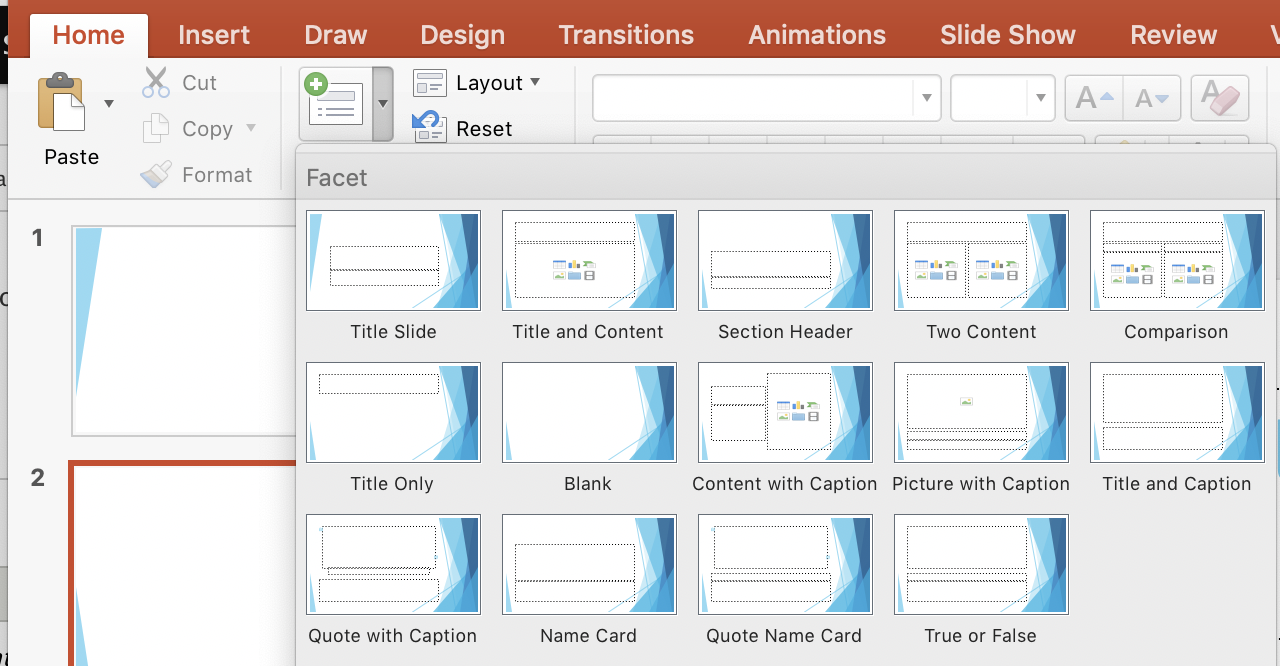
Accessibility Tips
- Using pre-existing slide layouts preserves the reading order, which is essential for screen reader users. For more details, see the Check Reading Order section.
- Avoid adding extra elements to a slide unless absolutely necessary, as they can disrupt how content is read by assistive technology.
- Slide titles are critical for accessibility. Every slide should include a title, even if it is visually hidden. See the Slide Titles section for more guidance.
Using Slide Masters
Each slide layout comes with pre-set font and paragraph styles, but these can be modified. Rather than changing the style on each slide individually, you can set default styles for the entire presentation using the Slide Master. Consistent styles help maintain proper content structure and improve accessibility for screen readers.
Access the Slide Master
- From the main ribbon, select View.
Choose Slide Master.
Any changes made in the Slide Master view will apply to all slides that use that master layout.
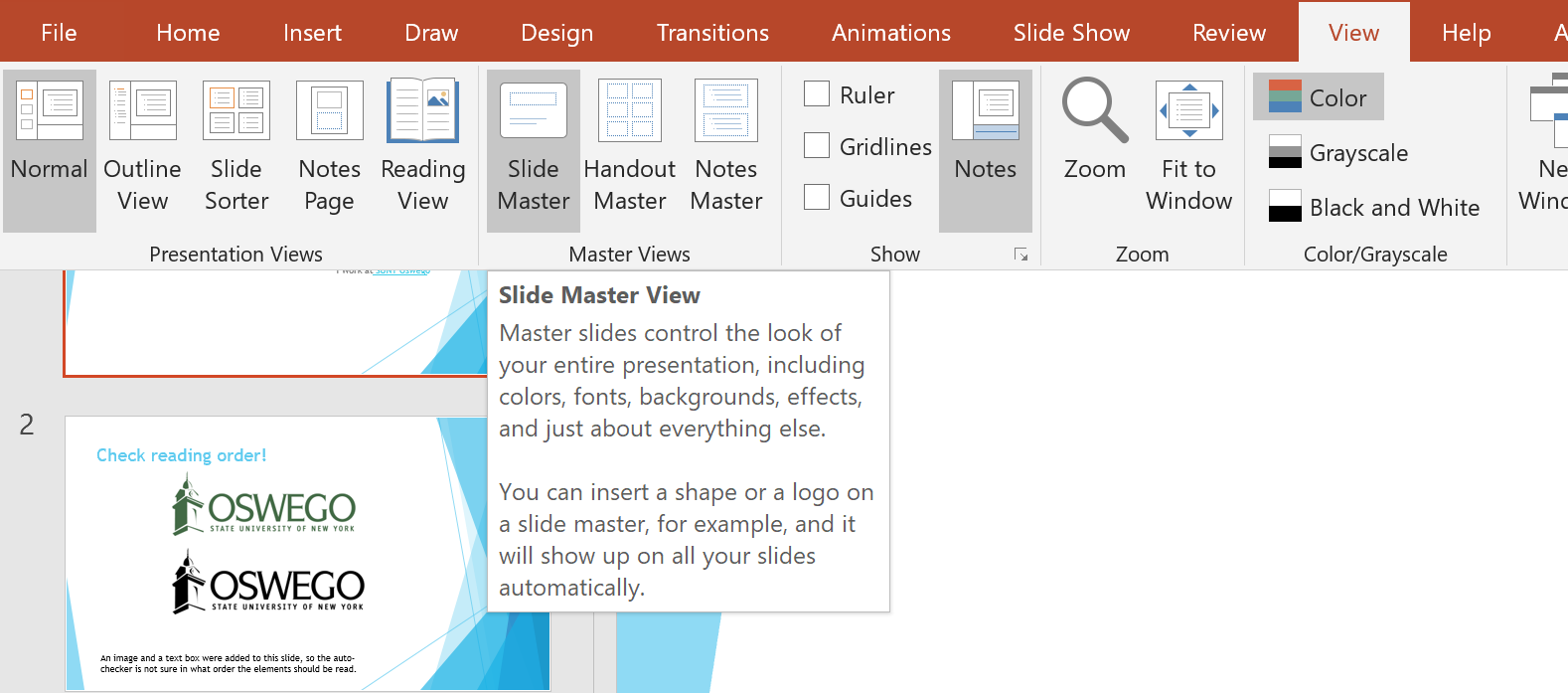
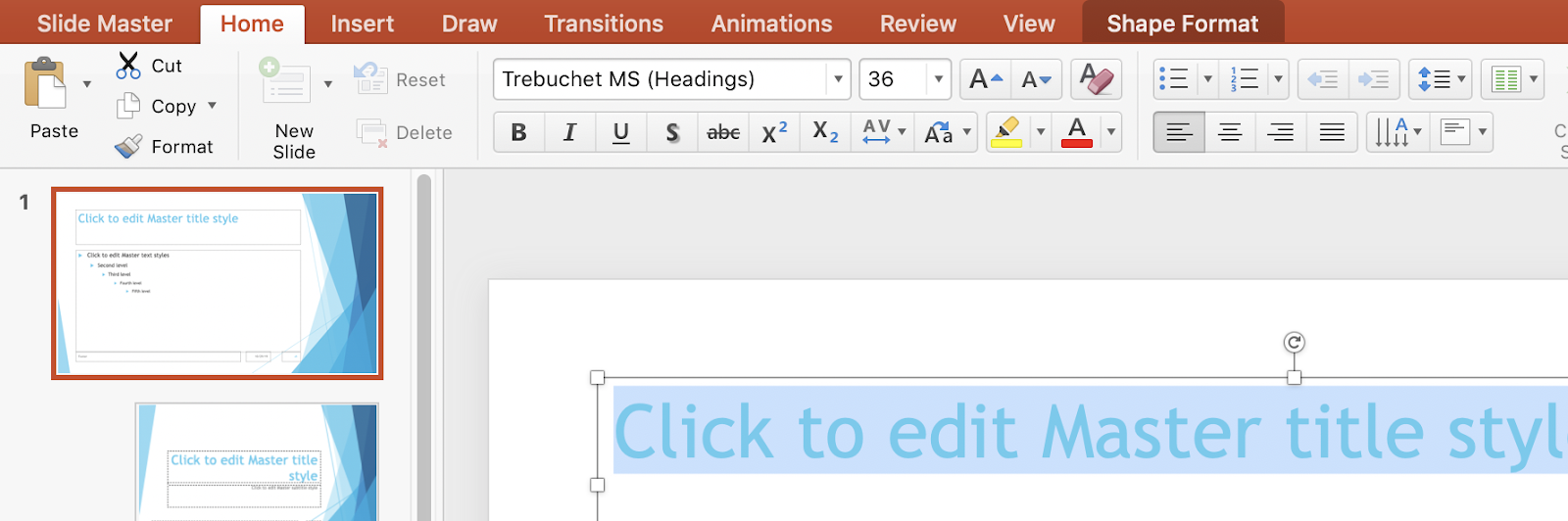
Modify Fonts and Paragraphs
- On the master slide, highlight the text you want to modify.
- Select the Home tab.
- Adjust Font attributes (type, size, color) or Paragraph attributes (alignment, list structure, line spacing).
Line Spacing
- Keep paragraph text at 1.5 line spacing for readability.
- Users with visual or cognitive disabilities may have difficulty tracking lines that are too close together. Lines that are too far apart may appear disconnected.
Heading Spacing
- The space after a heading should be slightly less than the space above the heading.
- To adjust, select Line Spacing from the format menu and choose to add or remove space before or after the element.
- When finished, select Close Master View to return to your presentation.
Pro Tip: Save Your Styles as a Theme
If you want to reuse your styles in future presentations:
- From the Slide Master tab, choose Themes.
- Select Save Current Theme.
- Enter a name in the Export As box.
- Ensure the Where field points to the Themes folder.
- Click Save.
Formatting Tips for Accessibility
- Use 24pt or larger for paragraph or bulleted text; headings should be larger.
- Use only one font throughout the presentation.
- Choose fonts designed for on-screen readability and widely available across devices, such as:
- Georgia
- Verdana
- Trebuchet
- Arial
- Calibri
- Gill Sans
- Corbel
- Calisto MT
Following these formatting practices helps ensure your slides are readable and accessible for all users.
Slide Titles
Each slide should include a unique title, which helps assistive technology identify and navigate slides. Even if a title is not visually needed, it should be present for accessibility purposes.
Add or Hide a Slide Title
- From the main ribbon, select the Home tab.
- In the Arrange section, choose Selection Pane.
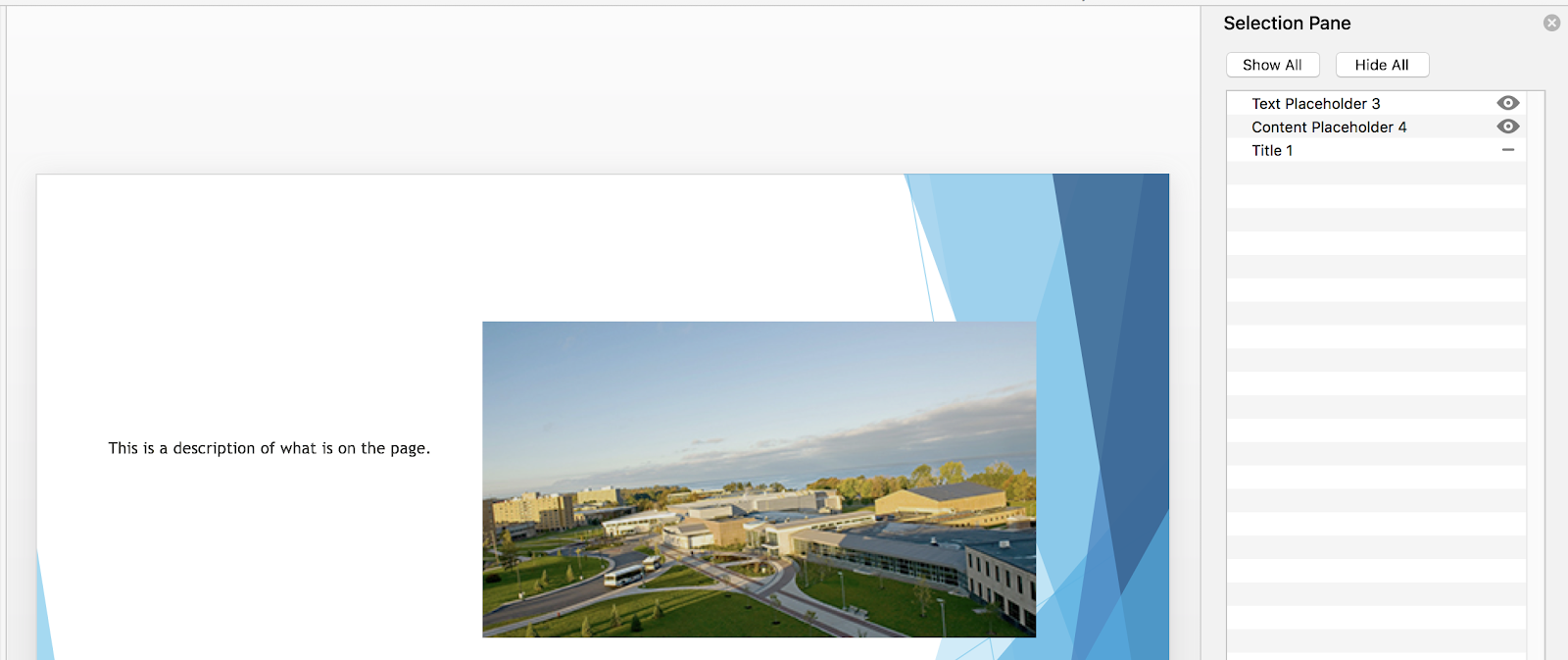
- The Selection Pane displays all objects on the slide.
- Use the eye icon next to the slide title to toggle its visibility.
Hiding a title keeps it available to assistive technology while removing it from the visual slide.

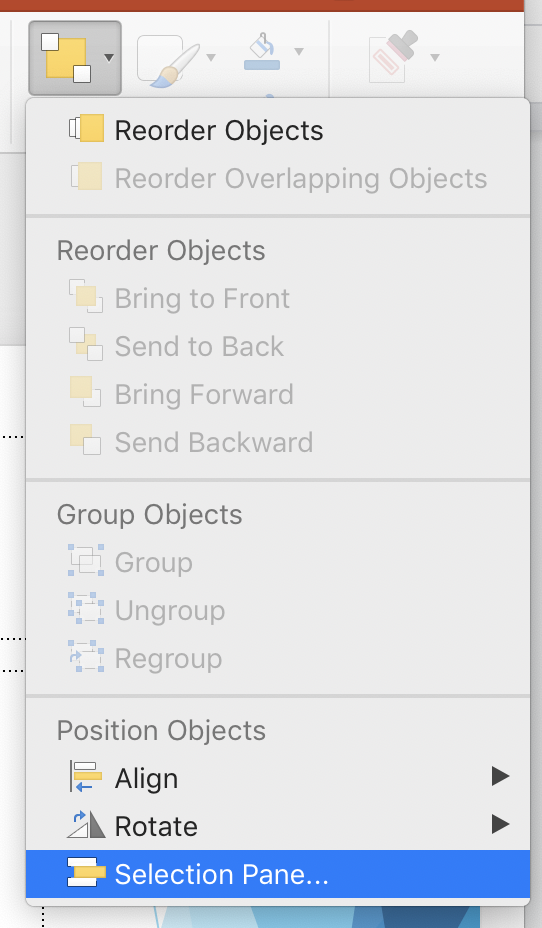

Make Titles Unique for Similar Slides
For slides with similar content, each title should be slightly different to help users distinguish between slides.
Examples:
- Features of Campus (1 of 3)
- Features of Campus (2 of 3)
Features of Campus (3 of 3)
or
- Features of Campus (continued)
Unique slide titles allow screen reader users to:
- Understand where they are in the presentation
- Move efficiently from slide to slide
Text Equivalents with Alt Text
All images in a PowerPoint presentation should include alternative text (alt text). Alt text provides a description that conveys the meaning or context of an image to users who cannot view it directly, such as those using screen readers.
Add Alt Text to an Image
- Select the image in your slide.
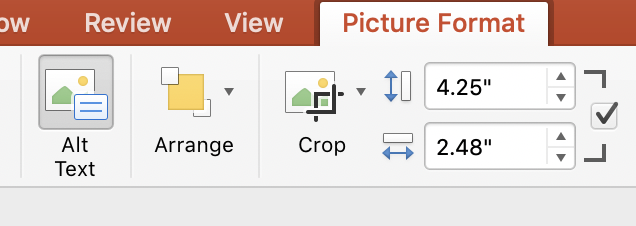
- From the ribbon, select the Picture Format tab.
- This tab is hidden unless the image is selected.
- Click Alt Text.
Alternative method:
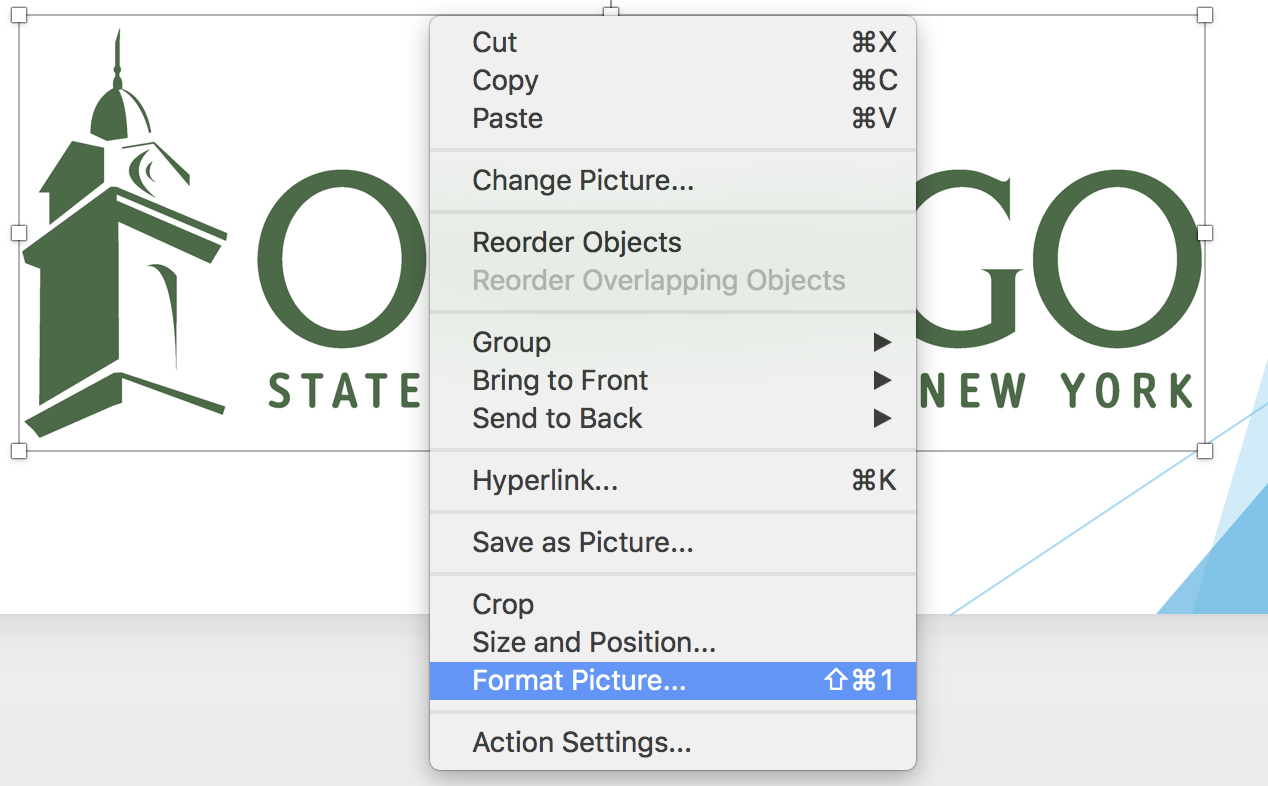
- Right-click the image and choose Format Picture.
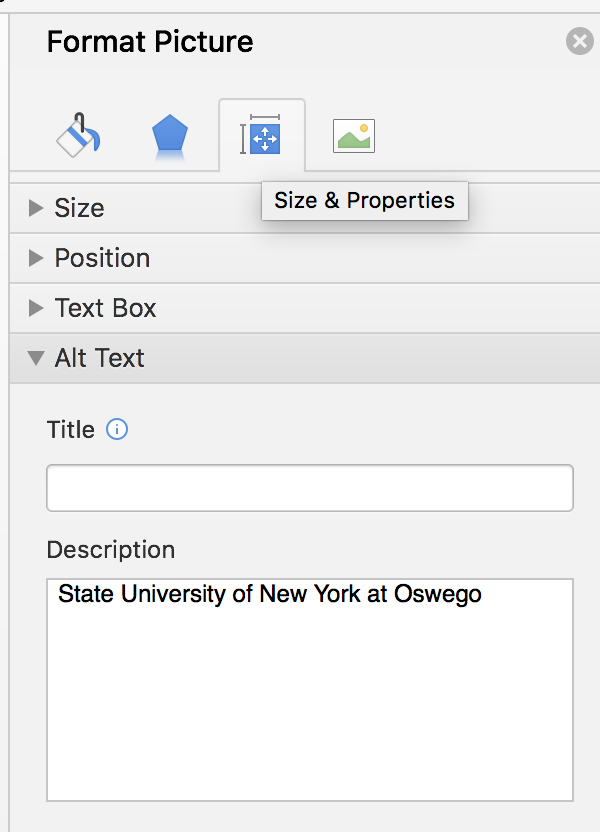
- Select the Size and Properties tab, then choose Alt Text.
Write Effective Alt Text
- Provide a full description in the Description box.
- Example: For the SUNY Oswego logo, type: State University of New York at Oswego
- For complex images like chards, graphs or diagrams:
- Use the Title field for a brief label (e.g.: Enrollment by Year)
- Provide a full description in the Description box that explains the data or key information.
- For decorative images that add no meaningful content:
- Check the Mark as Decorative box or consider removing the image entirely.
- Do not use the "Generate a description for me" button.
- As the presentation designer, you are responsible for ensuring alt text accurately conveys the purpose and meaning of the image.
Providing clear, intentional alt text ensures all users, including those using assistive technology, receive the same information as visual users.
Provide Descriptive Hyperlinks
Hyperlinks in a digital document should be embedded within meaningful text to improve readability and accessibility. The linked text should clearly indicate where the link goes and make sense even when read out of context.
- Do not use vague phrases like “click here” or “read more”.
- Avoid linking entire sentences; keep link text concise and descriptive.
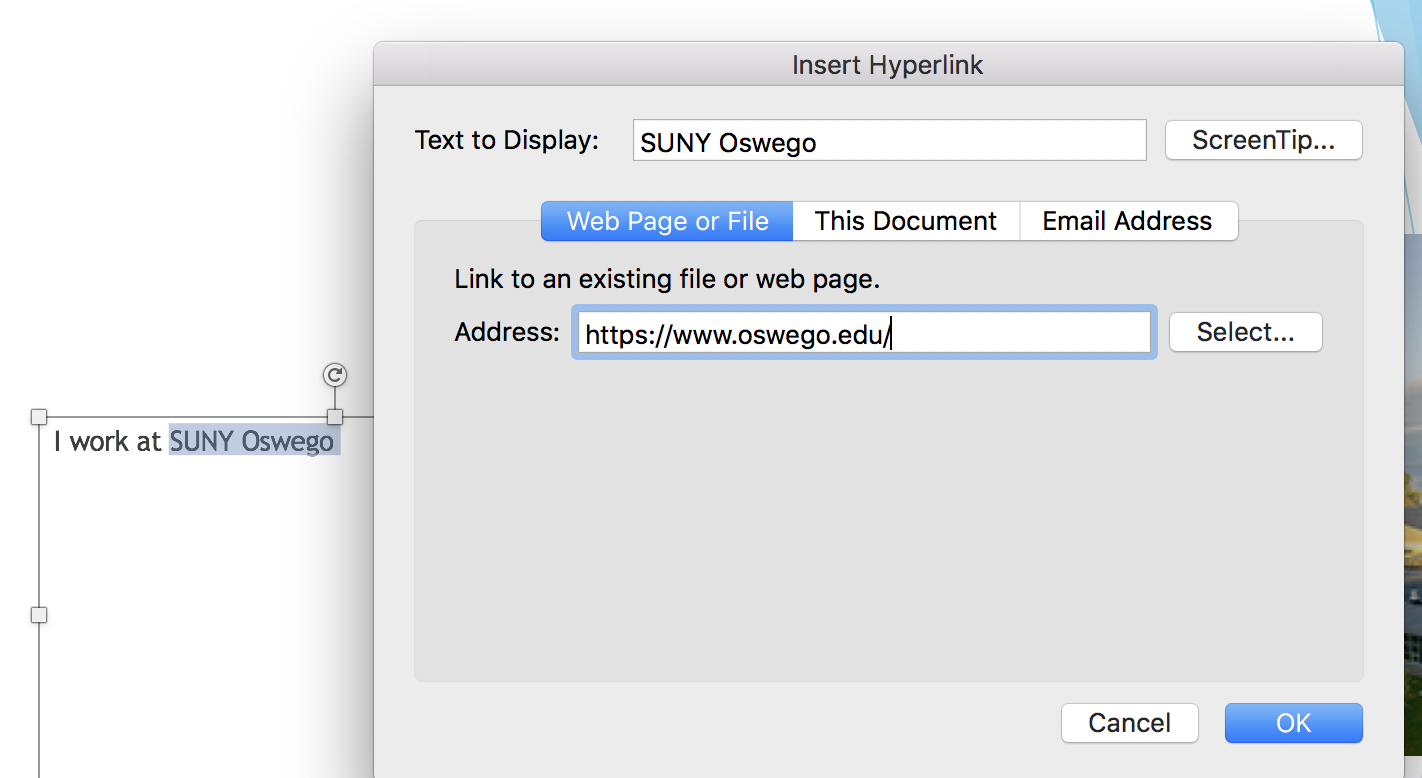
Imagine you have the sentence “I work at SUNY Oswego” in your document and you want the words SUNY Oswego to link directly to the college’s website.
Add a Hyperlink on a Mac
- Highlight the text you want to turn into a hyperlink (e.g., SUNY Oswego).
- From the ribbon, select the Insert tab.
- Click Link.

Link Options
- External Web Page
- Choose Web Page or File.
- Enter the full URL in the Address field (e.g., https://oswego.edu).
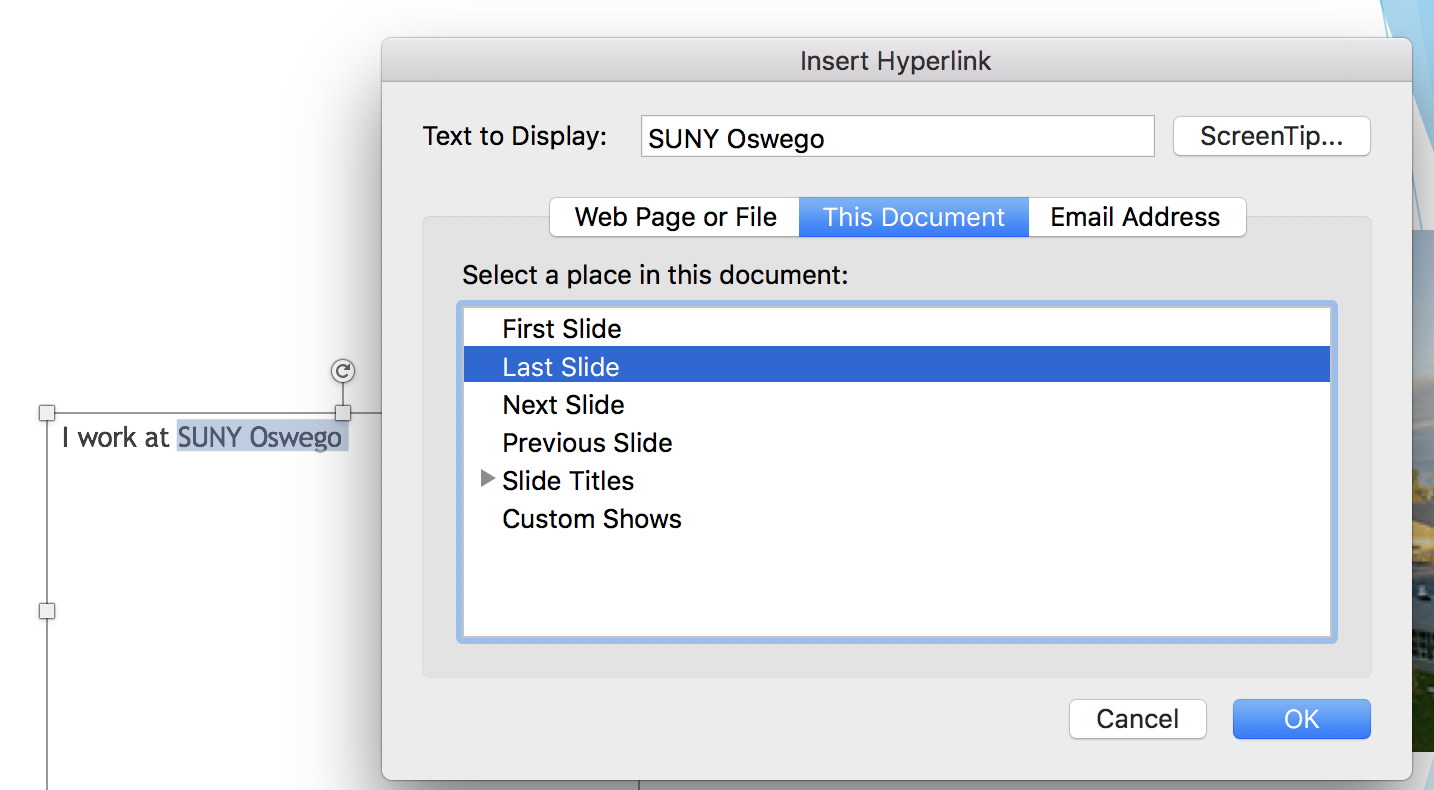
- Slide Within the Document
- Choose This Document.
- Select the slide you want to link to.
- Click OK to create the hyperlink.
Using descriptive, meaningful link text ensures that all users, including those using screen readers, understand the purpose and destination of each link.
Creating Accessible Tables
Tables should be used only for tabular data, not for layout or visual design. Properly structured tables allow screen readers to:
- Identify the number of rows and columns
- Read column and row headers
- Navigate the table one cell at a time
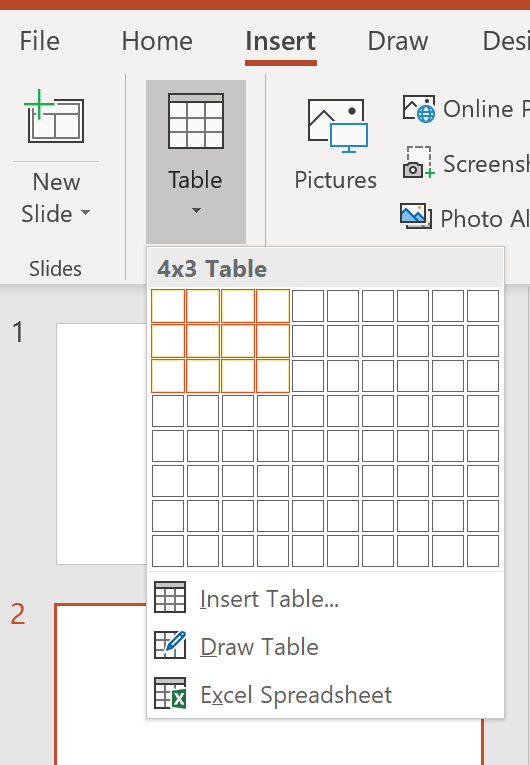
Insert a Table
- From the main menu, select the Insert tab.
- Click Table. A drop-down grid will appear.
- Either:
- Highlight the number of rows and columns you want, or
- Choose Insert Table from the menu and enter the desired number of rows and columns.
Tip: Avoid using tables for layout purposes; this can confuse screen readers.

Define Table Headers
- Click inside the table.
- Under the Table Tools section, select the Design tab.
- Ensure the Header Row and First Column checkboxes are selected.
Proper header definitions allow assistive technology to correctly interpret the table’s structure.

Style Table Content
You can format text within table cells to improve readability without breaking accessibility:
- Highlight the cell, row, or column you want to style.
- From the main menu, select the Home tab.
- In the Font and Paragraph sections, apply formatting such as:
- Font type and size
- Font color
- Text alignment
- Line spacing
Tip: Styling should enhance readability while maintaining the table’s structure and header information.
Check Reading Order
When elements are added to a slide layout, the order in which they are read by a screen reader may not match the visual order. This can trigger a “Check reading order” warning in the accessibility checker.
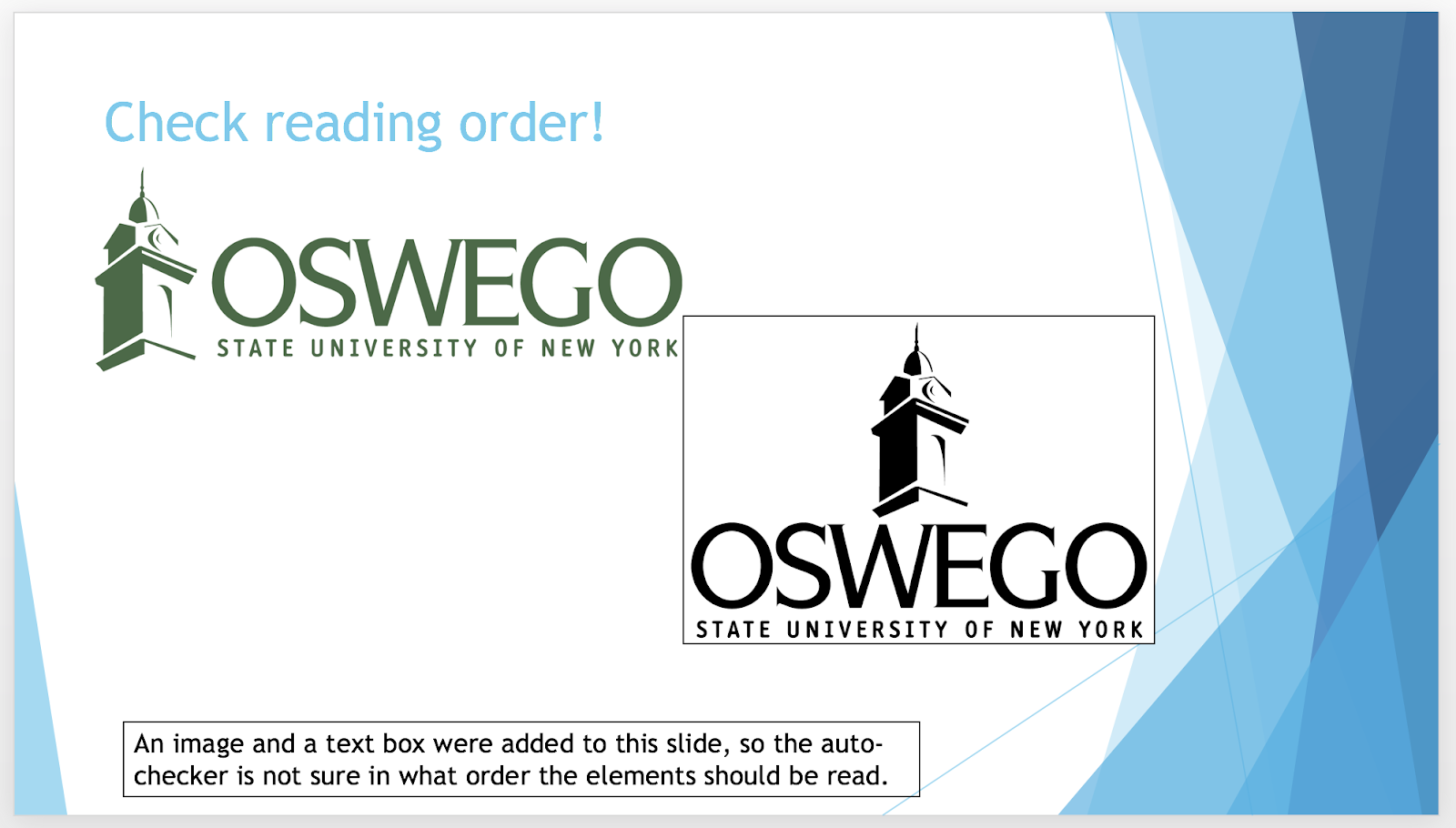
Verify or Change Reading Order
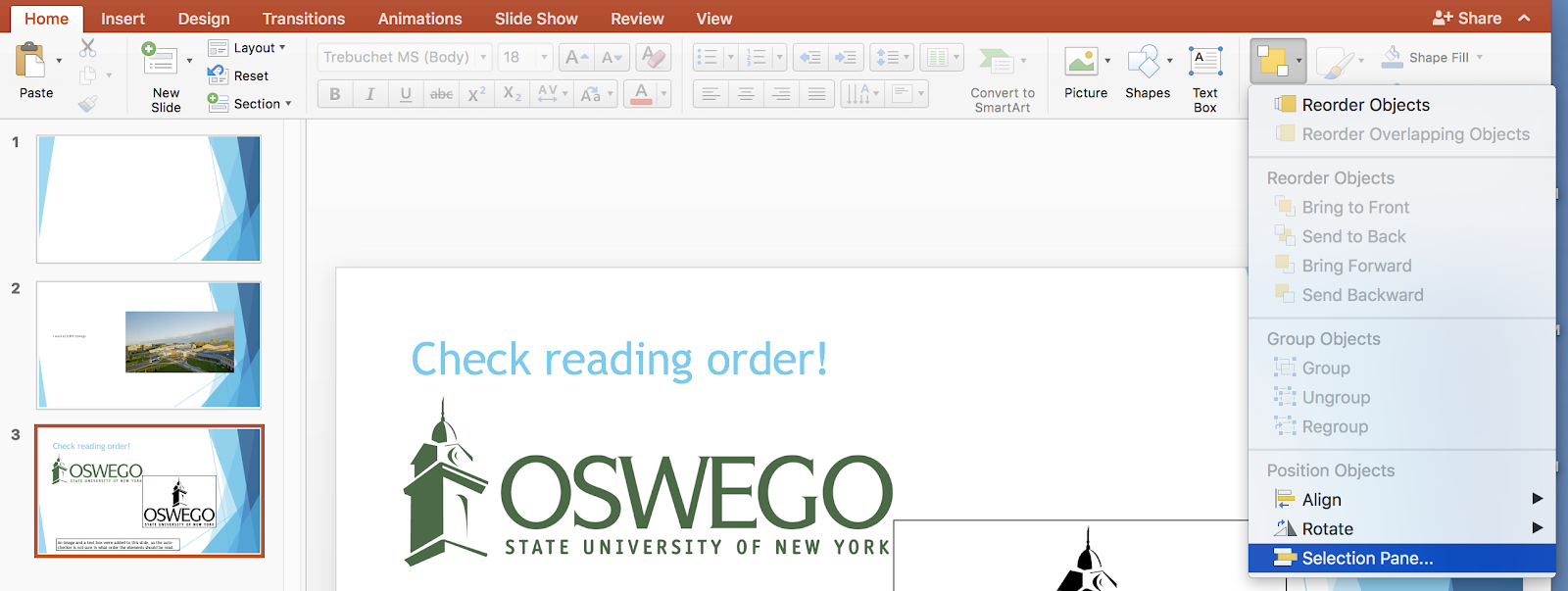
- From the main ribbon, select the Home tab.
- In the Arrange section, choose Selection Pane.
- This displays all objects on the slide.
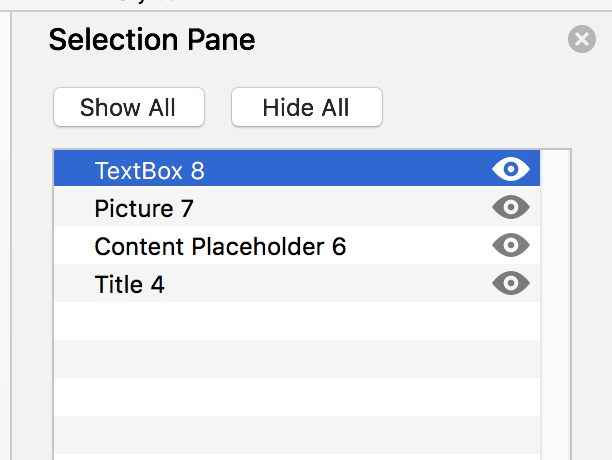
- Objects are read by assistive technology starting with the bottom item in the list and ending with the top item.
Highlight an item in the Selection Pane to see which element it corresponds to on the slide.
Example: A newly added text box (Textbox 8) appears at the bottom of the list, meaning it will be read first. If it should be read last, it needs to be moved to the top of the list.
- Objects will be read by assistive technology beginning with the bottom list item and ending with the top item.
- Highlight an item name in the Selection panel to see which item in the slide it corresponds to. In this example, the added text box (textbox 8) is the first on the list to be read (because it’s at the bottom). This should be the last item to be read, so it needs to be moved to the top of the list.

Reorder Elements
You can adjust the reading order using either method:
- Drag and drop: Use the mouse to drag items to the correct position in the list.
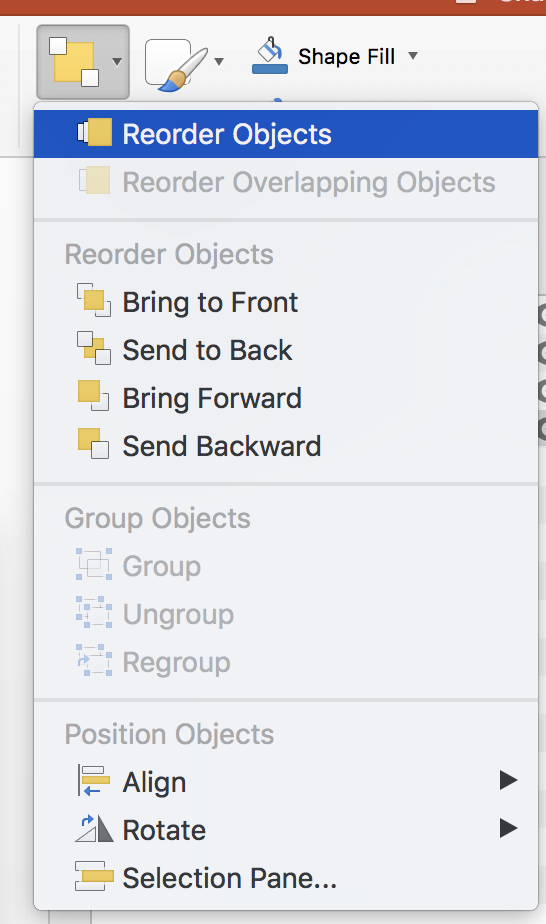
- Reorder Objects menu: From the Arrange section, choose Reorder Objects, then use the arrow keys or mouse to move elements to the proper order.
Ensure that elements are read logically, such as the main title first, followed by logos, and then supporting text.


Example: Corrected Reading Order
After moving Textbox 8 to the top of the Selection Pane, the reading order would be:
- Title 4 – “Check reading order!”
- Content Placeholder 6 – Green logo with cupola on side
- Picture 7 – Black logo with cupola on top
- Textbox 8 – “An image and a text box…”
This ensures that screen readers present the content in a logical, meaningful sequence.
Run an Accessibility Check
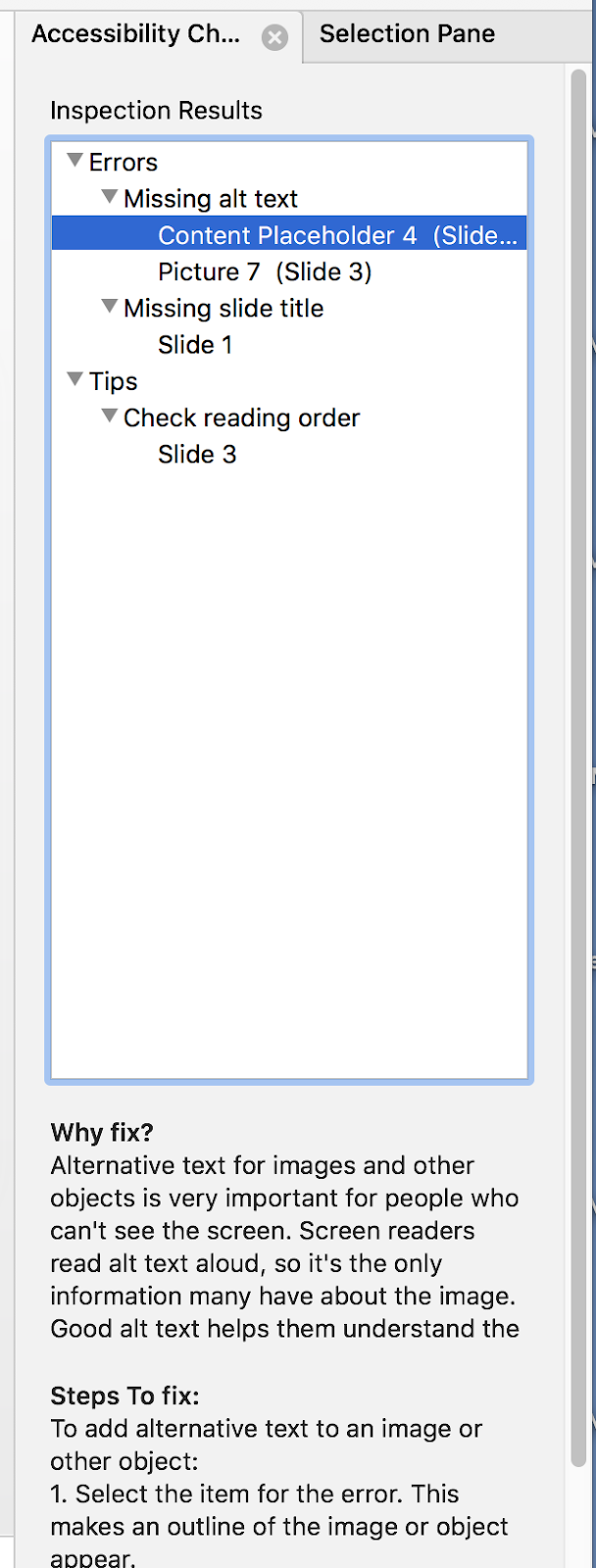
PowerPoint includes a built-in accessibility checker to help identify issues before sharing your presentation. This tool highlights content that may be difficult for users with disabilities to access.
Steps to Check Accessibility
- From the main ribbon, select the Review tab.
- Click Check Accessibility.

- A sidebar will open, listing errors, warnings, and tips.
- Highlight each issue to see guidance on how to fix it.
Resolve Accessibility Issues
- Address each issue one at a time throughout the presentation.
- After making corrections, click the Check Accessibility button again in the Review tab to generate an updated report.
- Repeat this process until all checks have passed.
Using the accessibility checker ensures your slides are readable, navigable, and usable for everyone, including users who rely on screen readers or other assistive technology.
Converting to a PDF
When you save or export a PowerPoint presentation to another format, such as a PDF, some accessibility features may not fully carry over, even if the original PowerPoint is fully accessible.
If you convert your presentation to a PDF:
- Review the PDF in Adobe Acrobat Pro using its built-in accessibility checker.
- Fix any accessibility issues before distributing the file.
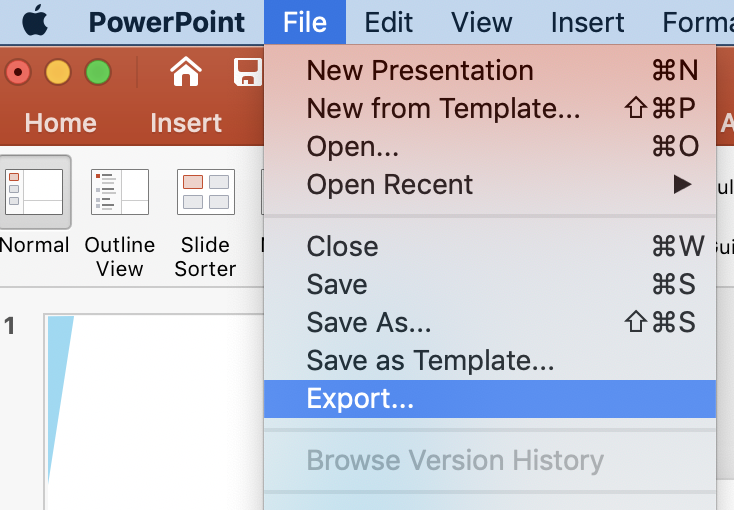
Export as a PDF on Mac
- Click the File tab.
- Select Export.
- Choose PDF as the file format.
Important: Using Save or Save As may not preserve all accessibility features from PowerPoint. Always use Export for better accessibility retention.
Additional Resources
- Article, “Make your PowerPoint presentations accessible” from Microsoft Office Support
- Article, “Learn how to navigate PowerPoint using accessible features,” from Microsoft Office Support
- Article, “PowerPoint Accessibility” from WebAIM
- Article, “How to Make Your Presentations Accessible to All” from W3C