Criminal Justice Student Research

Research Presentations

The Department of Criminal Justice encourages students to engage in research that explores contemporary issues in crime, justice, media, policy, and society. Through coursework, independent projects, and faculty mentorship, students develop research skills, analyze complex topics, and communicate their findings to diverse audiences.

Many of these projects are presented at SUNY Oswego's annual Quest symposium, a campus-wide celebration of scholarly and creative activity that provides students with opportunities to share their work through presentations, posters, panels, and discussions. This page highlights research and presentations by Criminal Justice students and showcases the innovative work being conducted across the department. Explore the projects below to learn more about the questions our students are asking and the discoveries they are making. (SUNY Oswego)

Featured Presentations and External Showcases
In addition to Quest presentations, students may also present their work through community partnerships, conferences, and digital platforms. Selected projects and presentation links are featured throughout this page.

Criminal Justice & Research

Quest 2026 Presentations

  • How Social Media Impacts Criminal Trials
  • Violent Video Games: Do They Truly Increase Aggression and Crime?
  • Gang Narratives in Movies, Television, and Digital Media
  • True Crime's Rise in Popularity
  • Social Media Algorithms and the Public's Exposure to Crime
  • Recent Depictions of Serial Killers in the Media
  • Women in Crime Media
  • Marvel, DC, and Beyond: Hypersexualization in Comics
  • The Effects of Profile Pictures of Top Dark Triad Scorers
  • Perceptions of Domestic Violence in the Media
  • The Influence of Jealousy on Social Behavior and Predicting Jealous and Abusive Relationships
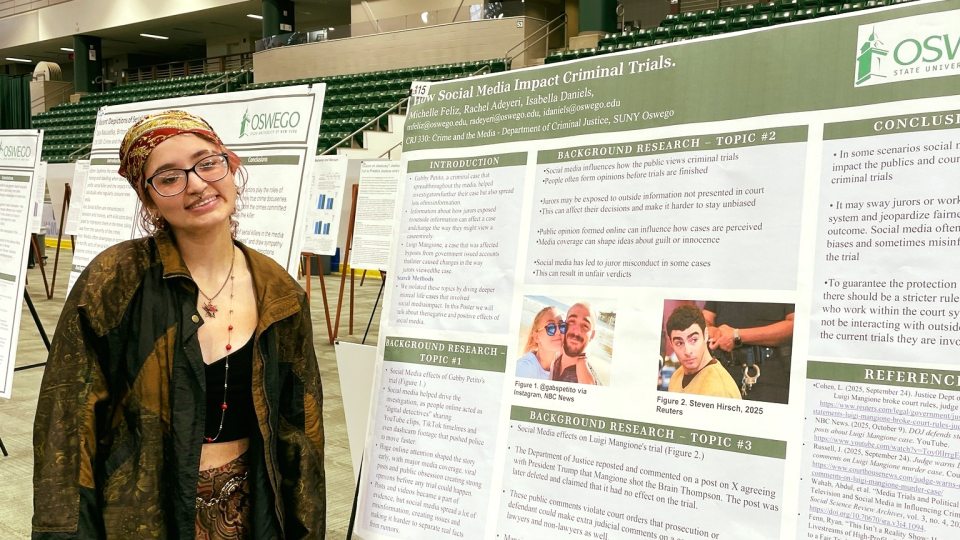
A SUNY Oswego student wearing glasses, a green jacket, and a patterned skirt stands smiling in the Marano Campus Center next to her large research poster.

Social Media's Impact on Criminal Trials

Criminal Justice students Michelle Feliz, Rachel Adeyeri, and Isabella Danielo presented research at Quest 2026 examining how digital commentary and public platforms influence jury bias and court integrity. Their findings highlight the urgent need for stricter social media policies within the legal system to guarantee fair trials in the digital age.

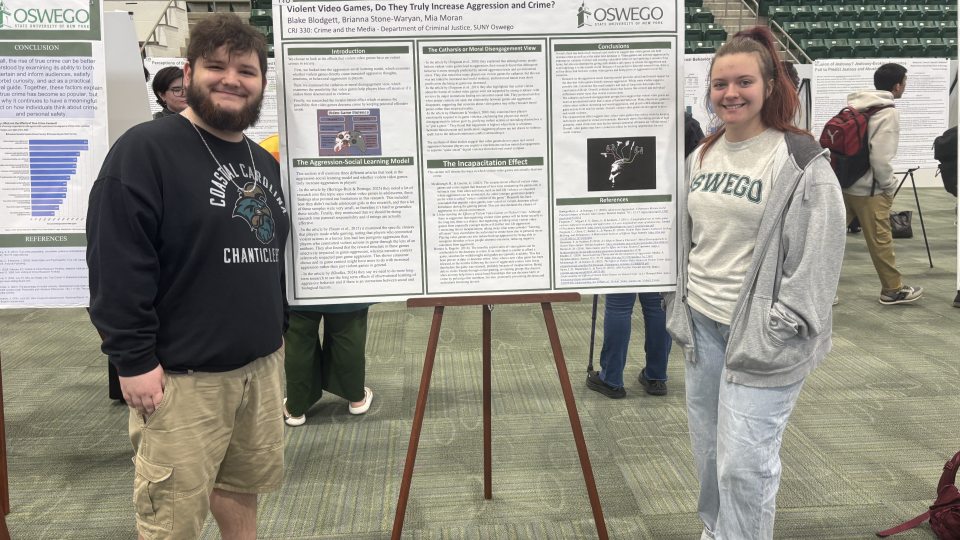
Two students stand beside a research poster at SUNY Quest 2026 inside an arena-style venue. Blake Blodgett stands on the left and Brianna Stone-Waryan stands on the right next to their Criminal Justice research presentation on violent video games and aggression.

Poster: Violent Video Games, Do They Truly Increase Aggression and Crime?

CRJ 330 research project, by Blake Blodgett and Brianna Stone-Waryan, examined whether violent video games contribute to aggression and criminal behavior. The presentation explored theories including catharsis, moral disengagement, social learning, and incapacitation while evaluating how gaming may influence attitudes and behavior.

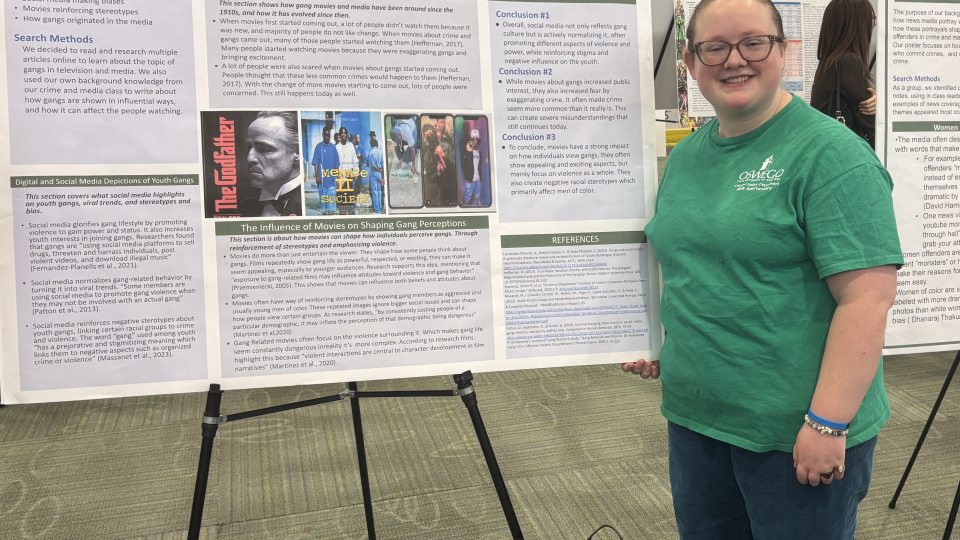
Charley Skellington-Bice stands smiling beside a research poster at SUNY Quest 2026 focused on gang portrayals in movies, television, and digital media.

Poster: Gang Narratives in Movies, Television, and Digital Media

This CRJ 330 project by Charley Skellington-Bice, explored how gangs are represented across media platforms and how these portrayals shape public perception. The research examined stereotypes, social media influence, and the role of entertainment media in reinforcing or challenging narratives about gang culture.

Two students stand beside their research poster at SUNY Quest 2026. Mikeal Halpainy-Livermore stands on the left and Laura Winfield stands on the right presenting their Criminal Justice research on the growing popularity of true crime media.

Poster: True Crime’s Rise in Popularity

This CRJ 330 research project by Mikeal Halpainy-Livermore and Laura Winfield, investigated why true crime media has become increasingly popular. The presentation discussed themes such as morbid curiosity, entertainment, education, and survival awareness while examining how true crime influences audiences and perceptions of crime.

 
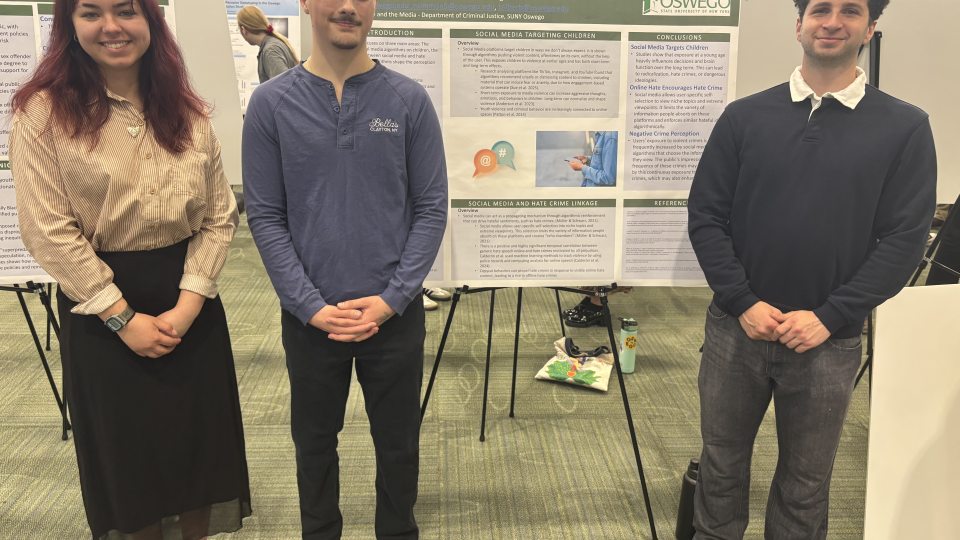
Three Criminal Justice students stand in front of their SUNY Quest 2026 research poster. From left to right are Nina Simmons, Jacob Johnston, and Tomer Zilberberg, presenting their project on how social media algorithms influence public exposure to crime-related content.

Poster: Social Media Algorithms and the Public's Exposure to Crime

This CRJ 330 research project by Nina Simmons, Jacob Johnston, and Tomer Zilberberg, examined how social media algorithms shape users' perceptions of crime by prioritizing certain content. The presentation explored the effects of targeted content on children, links between social media and hate crimes, and how repeated exposure to crime-related posts can influence public perceptions of safety and criminal behavior.

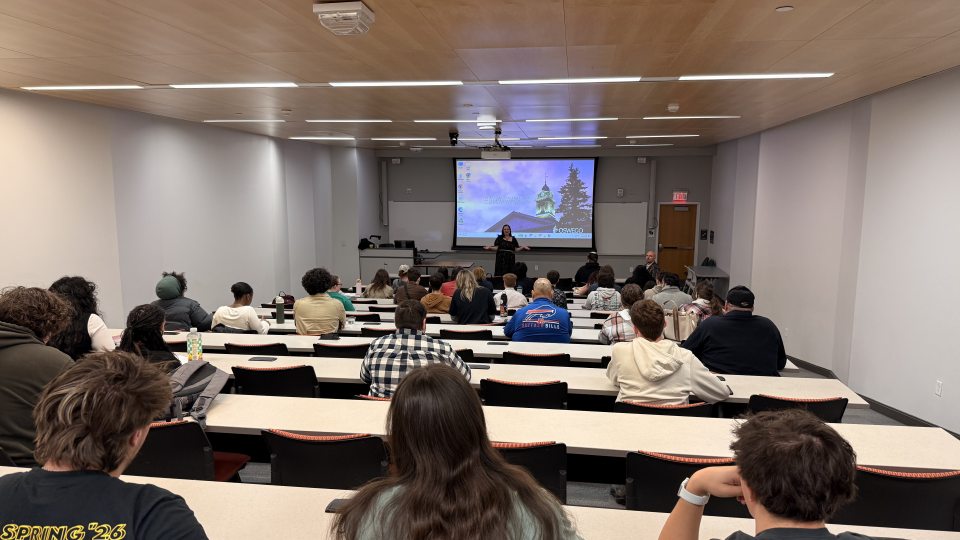
Students and faculty attend a Criminal Justice research panel in a SUNY Oswego classroom. Audience members are seated while student researchers present findings from projects examining crime, media, public perception, and contemporary criminal justice issues.

Crime and the Media Research Panel

As part of SUNY Quest 2026, Criminal Justice students participating in CRJ 330: Crime and the Media presented their research through a panel discussion and poster presentations. Students shared findings on topics including true crime, social media, media portrayals of crime, gangs, violence, and public perceptions of the criminal justice system, demonstrating the department's commitment to undergraduate research and scholarly engagement.

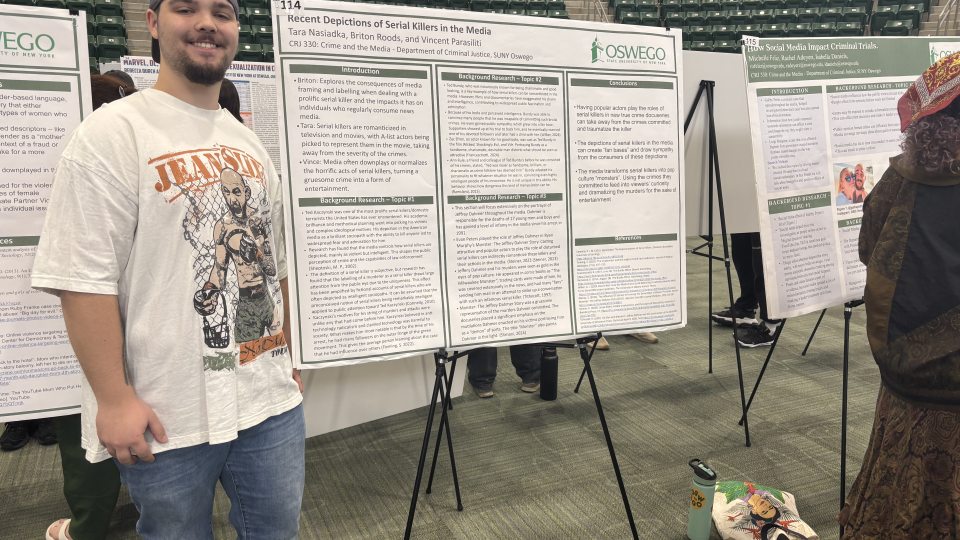
Vincent Parasiliti stands beside his SUNY Quest 2026 research poster examining recent portrayals of serial killers in television, films, documentaries, and popular media.

Poster: Recent Depictions of Serial Killers in the Media

This CRJ 330 project by Vincent Parasiliti, explored how modern media depicts serial killers and how those portrayals influence public understanding of crime. The research examined media framing, dramatization, public fascination with true crime, and the ways entertainment media can shape perceptions of offenders and violent crime.