
Sustainability Office, Penfield Library, SUNY Press team up for tree planting
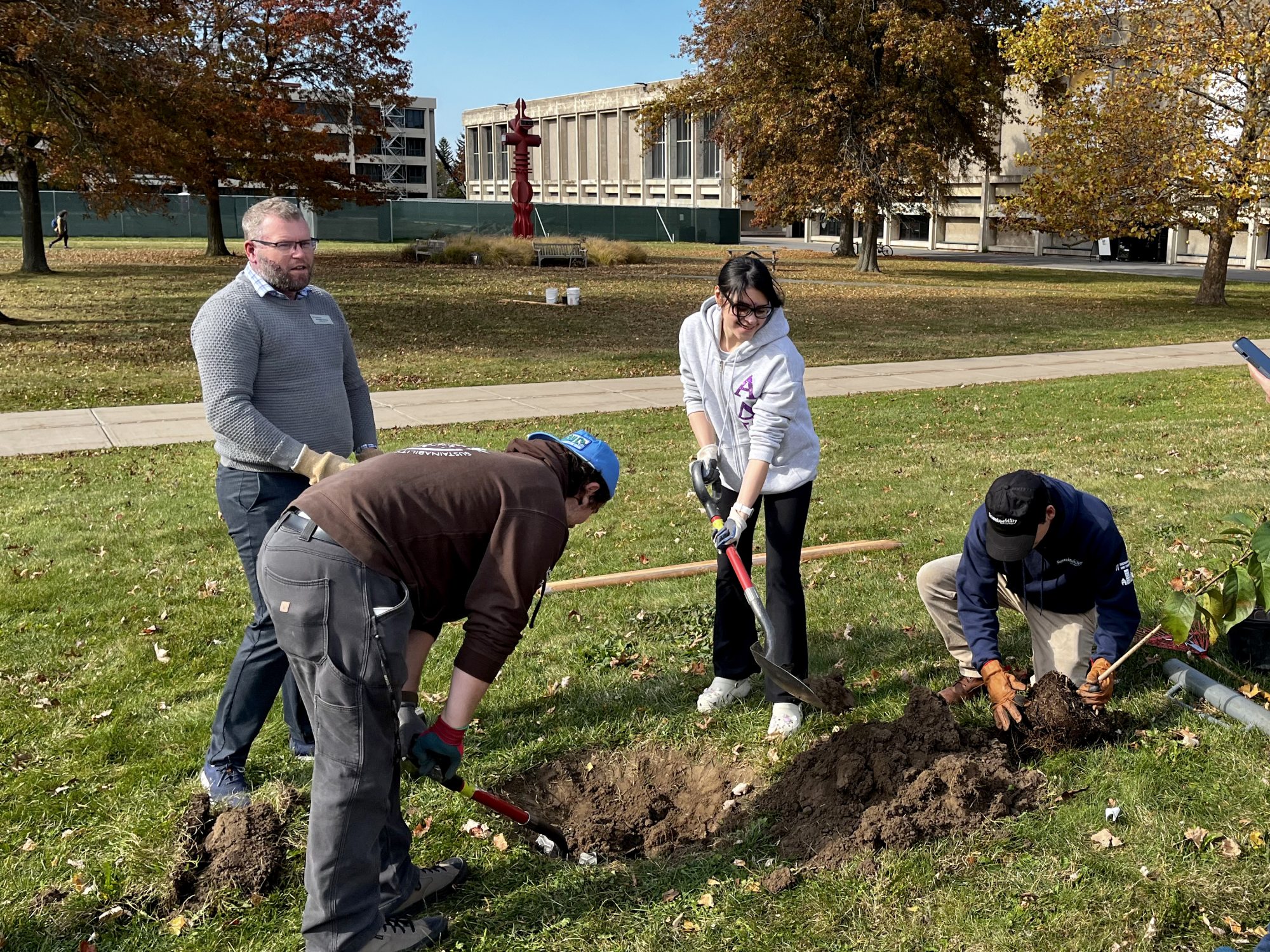
SUNY Oswego’s Sustainability Office and Penfield Library teamed up with SUNY Press on a tree planting that was part of the system’s publishing arm’s celebration of 60 years by planting 60 trees across SUNY campuses.
A crisp fall day on Oct. 28 provided the backdrop as students, faculty and staff planted two pawpaw trees and a pecan tree in the quad, near Penfield Library.
“We're super happy that this project lined up in such a nice fashion with a project we already had going on campus,” said Maxon Ali, Oswego’s sustainability coordinator. “That project is our Great Lakes Restoration Initiative, where we're planting 250 trees on SUNY Oswego's grounds.”
This campus and community planting project will plant 400 trees in all, with a second planting site at St. Luke Health Services in the city of Oswego.
Tanja Eise, director of marketing and sales for SUNY Press, said she was especially pleased to attend the event in person because of how organized the university partners are as well as the beauty of the campus.
“You've done such an incredible job tying this all together, so thank you,” Eise said. “I really appreciate it.”
SUNY Press also donated books from their Growing Forward reading list to the library, dovetailing with other efforts including Oswego’s Seed Share library, where members of the campus community can borrow seeds for planting and/or loan seeds back for others to use.
“Seeing the Growing Forward books on display at Penfield Library near the very cool seeds in a card catalog is something I'll remember,” Eise said. “Ideas and seeds, both waiting for the right reader or the right ground. It was also a pleasure to see some students turn out for the planting, and to have (SUNY Oswego history professor) Gwen Kay there representing our Editorial Board.”
Other activities that day in Penfield Library included Emily DeLuca of the Sustainability Office leading a paper bookmark-making project and related artwork from Liz Hunt’s digital illustration classes. Additionally displays explained research at Rice Creek Field Station and around campus.
Observing milestones
Visiting partner SUNY Press is partnering on 60 tree plantings across campuses as they celebrate six decades “with a clear mandate to advance scholarship emerging from the State University of New York system and to contribute meaningfully to intellectual discourse,” according to a letter from SUNY Press Director Marlene McHugh Pratt on the SUNY Press website celebrating 60 years.
SUNY Press publishes around 150 books each year and has amassed a catalog of 6,000 titles across many academic disciplines. The tree plantings reflect a desire to continue to sustain this work well into the future.
“We’ve grown from our regional roots to publish authors from across the country and around the world, but we remain grounded in our founding purpose: to support research in the humanities and social sciences, enrich public dialogue and provide a platform for voices that might not otherwise be heard,” Pratt noted. “Through every book we publish, we aim to contribute something lasting to the scholarly conversation.”
For the university’s partners in cross-campus committees and workgroups supporting sustainability, it marked an occasion to celebrate progress as well.
“I'm happy to say we're almost done with phase three of planting now, where we complete our 250 trees on campus,” Ali noted. “Today, we're getting in three trees, two pawpaw trees and a pecan tree, right in front of the library, and hopefully that can inspire stewardship from library staff, faculty and students that just attend the library often.”
The root of the project involves a stormwater mitigation project, as the trees serve as natural infrastructure to help absorb water after rains. Otherwise, rain falling on impervious surfaces might flow directly into Lake Ontario.
But these plantings – and the choice of trees – are part of a larger goal to create an agroforestry area that can provide food to the campus.
“The 250 trees on campus will be either fruit-bearing, nut-bearing or medicinal trees,” Ali said. “These are all native, resilient species that have proven to do well in our region … trees that can provide food for us. So the idea is maybe when you're walking to your math class or your science class, you can pick a handful of blueberries, or you can pick a pawpaw. We're really turning campus into this living landscape where it's made available for students to harvest or at least interact with these trees that we're planting today.”
The Great Lakes Restoration Initiative, which also connects to Oswego’s designation as part of Tree Campus USA, additionally supports an expansion of the campus arboretum at the corner of Washington Boulevard and Sixth Avenue on the east edge of campus.
“We want to view campus as a whole as an arboretum, and getting in all these trees and documenting them properly is going to help us advance our campus, not to only having 100 trees there, but also looking at every tree as part of our Tree Campus USA designation,” Ali said.