
SUNY Oswego play ‘The Appliance Department’ explores what it means to be human
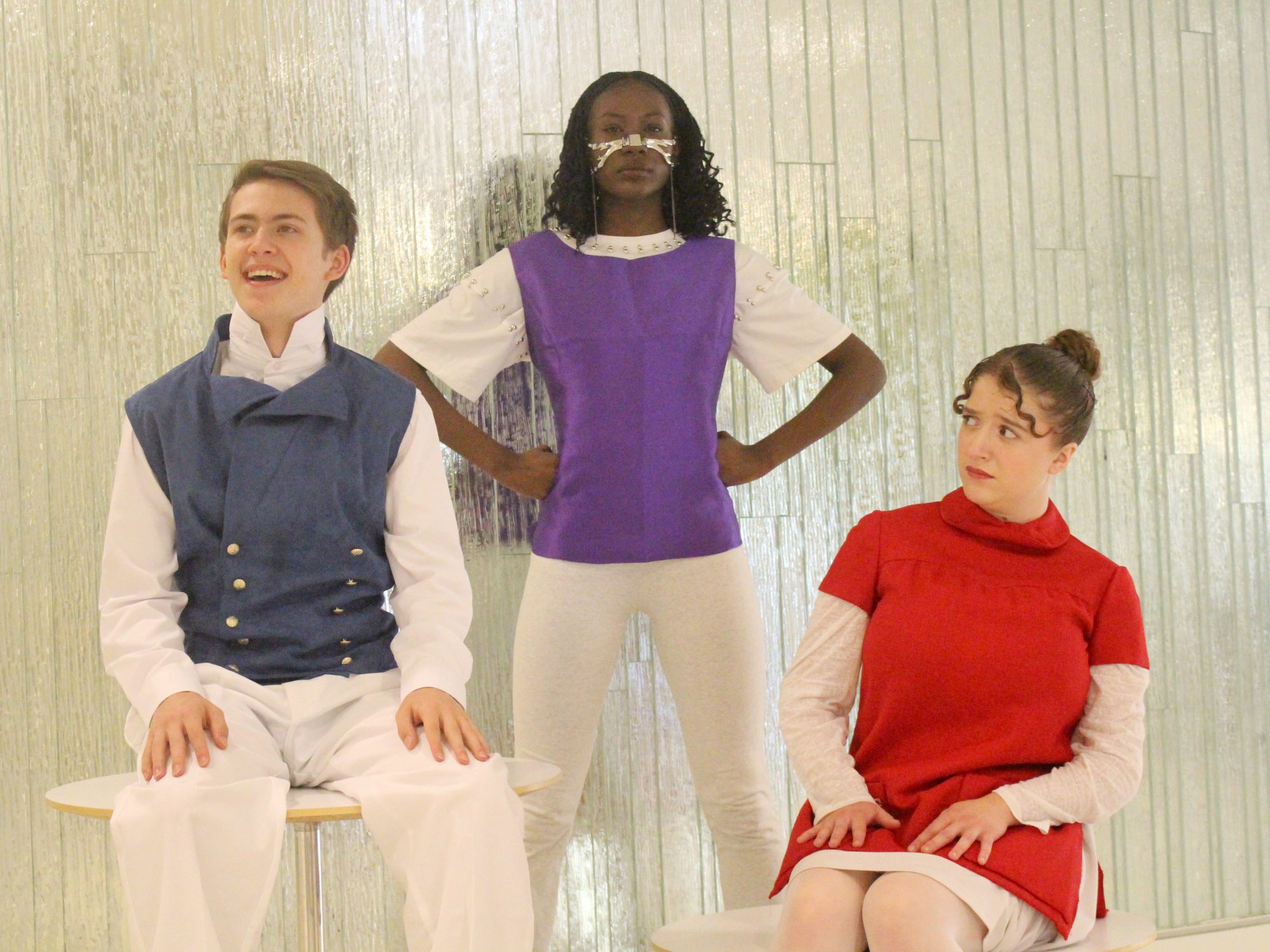
Starring as Robotic Companions (or RCs) in "The Appliance Department," opening SUNY Oswego's theatre season, are from left, Jevin Ray, Tara Turton and Tati Copp. Written by faculty member Bella Poynton, the new play raises questions about what it means to be human in a world of rapidly evolving technology. (Photo by Anni Foster)
As artificial intelligence becomes an increasingly present part of everyday life, SUNY Oswego’s first theatre production of this year looks at what it means to be human. Written by Oswego theatre faculty member Bella Poynton, “The Appliance Department” brings the conversation somewhere unexpected and not done very often: the stage.
The play follows a group of robotic companions, or RCs, displayed inside a department store and waiting to be purchased. While Ruby and Charlie desperately want a family, Violet wants freedom. Others begin to question whether being chosen is what they want at all.
In a world where robots are treated as appliances, displayed as commodities and valued according to what they can provide, questions naturally arise. Through them, Poynton explores some things far less artificial and more universal: personhood, belonging, agency and the definition of humanity.
“I think that robots are such a fascinating object because they are an extension of us,” Poynton said. “We’re trying to recreate ourselves in the robot, and it winds up not being quite us.”
AI enters the chat
The production arrives at Oswego during a moment when artificial intelligence is rapidly evolving across everyday life.
“We are dealing with and learning how to live in a world that has extremely fast-evolving AI technology,” said Poynton. “It is becoming something that we really need to think about and talk about. How are we going to deal with this? How is our world going to change?”
With Poynton being the playwright for the production, faculty director Jonel Langenfeld felt that this particular story needed to be staged now.
“Theatre is meant to educate, inform and challenge…this production isn’t taking any sides on AI; it is meant to help you make your own decision,” said Langenfeld. “As an artist, I do my best to affect change; this play is very timely – it's what I feel is important.”
Rather than just providing the audience with a linear answer about whether artificial intelligence should be feared or embraced, this production creates the space to question the nature of the relationship humans are developing with technology. More importantly, it's revealing what that relationship reveals about humanity itself.
Tara Turton, a sophomore theatre major from Queens, agreed. She plays Violet, one of the leading characters who seeks autonomy.
“This play offers lots of thinking pieces,” said Turton. “It makes you ask, ‘Are we getting programmed the same way RCs are? Are we just like them?”
That ambiguity also shapes how Langenfeld approaches how the robots appear onstage. Instead of showcasing the stereotypical mechanical robot, Langenfeld has encouraged the actors to find a space somewhere between artificial and human, capturing one of the play's strongest messages. To allow the robots to live within neutrality, innocence, and sincerity.
“They’re robots, but they don't act stereotypically robotic, but they’re not humans…there's this fine line,” said Langenfeld.
Turton saw herself in Violet, and it impacted how she played her.
”Seeing a robot wanting to start a revolution of rebellion for freedom and having that choice, I feel most aligned with Violet in her actions,” said Turton. “As a woman and a person of color, I also took my perspective into the performance.”
The result is a unique balancing act that places human actors in the bodies of artificial beings who are themselves attempting to understand human behavior.
The play’s the thing
Both Langenfeld and Poynton agree that, unlike film, theater’s sustained dialogue is an opportunity for characters to experience and wrestle with complicated ideas. In film, storytelling lives in images; in theatre, it lives in dialogue. That distinction is powerful.
“It's right in front of you,” said Langenfeld. “Live theatre, it is never the same, any night, any rehearsal, moment to moment it evolves. It is real, it’s raw, it's vulnerable.”
This production also offers students something they don't encounter with every show: the opportunity to work directly with the person who wrote the play.
Poynton has remained involved throughout the entire rehearsal process and continues to make subtle changes to the script as the production develops with the students.
Students can observe live rewrites and experience the process of how theatrical work evolves during rehearsals. When producing a 400-year old show, that experience doesn't exist. This is an experience many college-age theatre students – or many actors in general – have not encountered. For Langenfeld, that collaboration is part of what makes staging new work exciting.
“I thought it was going to be nerve-racking,” said Turton. “But I can ask the playwright [Bella] any questions I have…It’s amazing to see her say ‘I like this better’ and then write it in there.”
“That’s when you start to bring something to life,” added Langenfeld.
Poynton describes the production as funny, dark at times, visually ambitious alongside a spectacle within larger questions. She also points to something audiences don't get to frequently experience onstage: science fiction.
“It’s cool to be a part of something new,” Poynton said.
For Langenfeld, that newness also creates an opportunity for audiences to encounter the question surrounding AI without being told what to think. She hopes this production encourages audiences to listen, observe, and remain open to the possibilities presented onstage.
“I would like people also to walk away going, ‘Wow. That's a lot to think about. Wow, I want to know more about that,’” Langenfeld said.
“Everyone should come see this play,” added Turton.
Like the robots waiting to discover what comes next, perhaps audiences will, too.
“The Appliance Department” runs Oct. 14 to 16 at 7:30 p.m.; Oct. 17 at 2 and 7:30 p.m.; and Oct. 18 at 2 p.m., all in Tyler Hall’s Waterman Theatre.
Tickets are free for SUNY Oswego students, $12 for all others. Tickets and additional information are available on tickets.oswego.edu.
– Written by Jose Vazquez Nava of the Class of 2027