
SUNY Oswego partners with Syracuse City School District for multimillion-dollar mental health grant
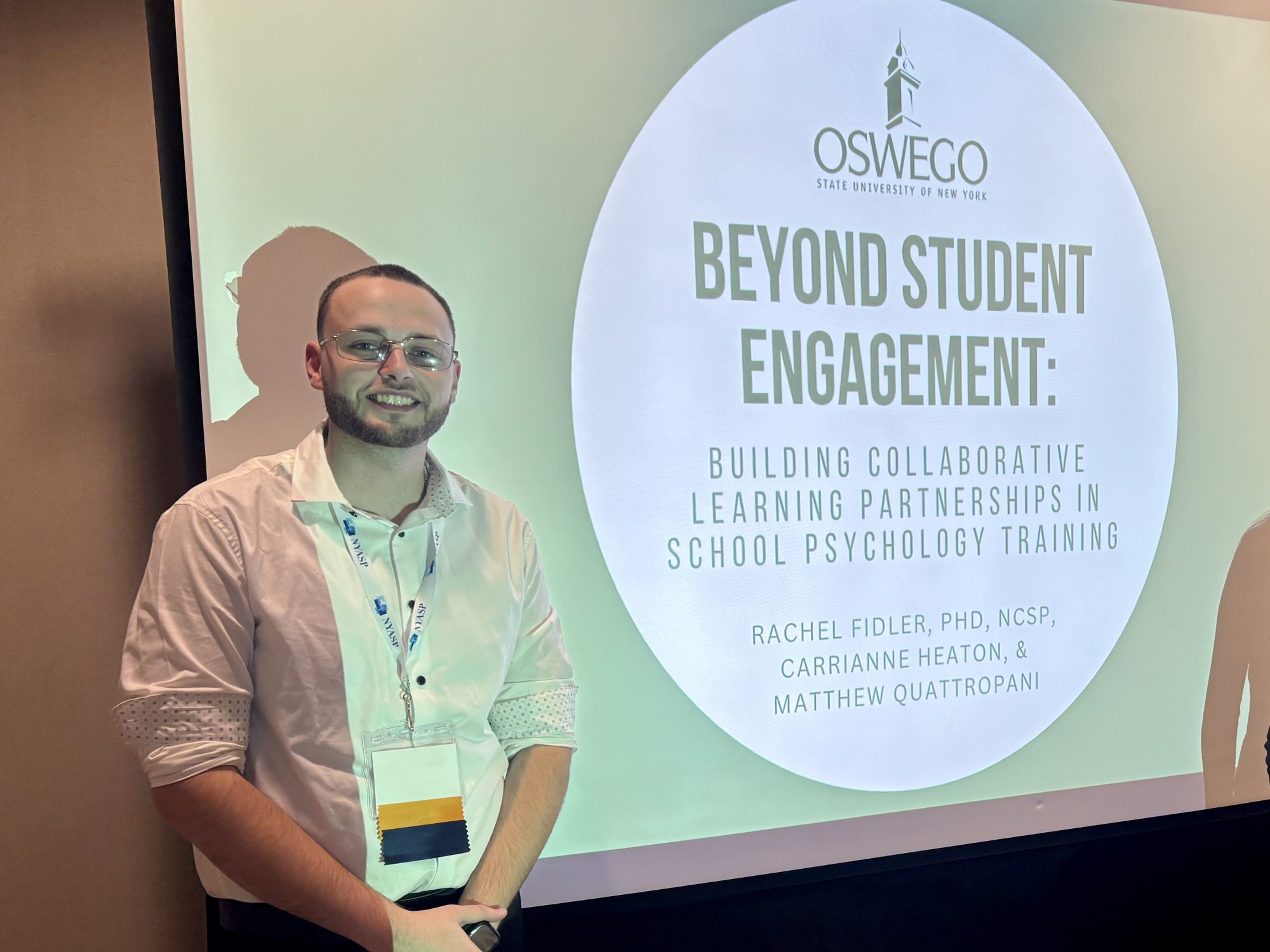
SUNY Oswego graduate student Matt Quattropani presents at the New York Association of School Psychology Conference in Albany. Thanks to a a $4 million federal grant received by the Syracuse City School District through the School-Based Mental Health Services Grant Program, Quattropani is one of the Oswego master's in school psychology students with paid placements with the district as well as professional opportunities like attending and presenting at the conference.
SUNY Oswego is a key partner for a $4 million federal grant received by the Syracuse City School District through the School-Based Mental Health Services Grant Program to expand access to mental health support for students and families.
Rep. John W. Mannion announced the funding this summer for the program beginning this fall, awarded through the U.S. Department of Education and supported by Mannion. The grant will provide approximately $1 million per year over four years to fund the partnership between the Syracuse City School District (SCSD) and SUNY Oswego to train, recruit and hire school psychologists and help address the urgent need for school-based mental health professionals in Syracuse schools.
Talented students in SUNY Oswego’s graduate program in school psychology will help increase the number of counselors, thanks to $63,984 in stipends in the project’s first year (with a total of $271,018 expected over four years).
One of the first participants, Matt Quattropani, is a graduate of the Syracuse City School District and was eager to be part of this effort.
“I was born and raised in Syracuse and went to schools here, so I’m giving back to the community I grew up in,” Quattropani said. “Once I learned about the opportunity to go back, I said, ‘that’s for me.’”
The coordinator for Oswego’s role in the grant, Michelle Storie of the Counseling and Psychological Services department, knows firsthand the importance of expanding mental health services as SCSD’s own efforts.
“Many years ago, I completed my own internship in the Syracuse City School District, and my first job as a school psychologist in the district,” Storie recalled. “Syracuse holds a near and dear place in my heart.”
SUNY Oswego currently has five students filling the internship, with an expectation for five more current second-year students to move into those positions in the 2027-28 school year. The university is currently recruiting first-year students for the following cohort, with a goal of five Oswego students filling those spots every year when viable.
Meeting key needs
“Students today face unprecedented pressure and mental health challenges. It’s important our schools have the trusted adults, trained professionals and resources they need to help every student succeed,” Mannion said in announcing the funding. “This federal funding will help Syracuse City School District and SUNY Oswego train, recruit and hire school psychologists so more students can get support where they are — in school.”
“This investment will help ensure more Syracuse students have access to the mental health support they need to learn, grow and thrive,” SCSD Superintendent Pamela Odom said when the funding was announced. “We are grateful to Congressman Mannion for recognizing this need and helping us build a stronger future for our students and families.”
The Syracuse City School District is the fourth-largest school district in New York state and serves students and families with significant unmet mental health needs, officials said. The new partnership with SUNY Oswego expands the pipeline of credentialed school psychologists while supporting immediate student needs in the district.
The new award builds on prior work the district has done to support efforts through its three existing school-based mental health clinics and two satellite clinics.
Laura Kelley, SCSD chief of student support services, noted the grant will prove pivotal in expanding district-wide school-based access to school-based mental health services by alleviating current staffing challenges and reducing student-to-psychologist ratios to provide students more timely interventions and support.
Kelley noted the grant and increased staffing also support providing earlier identification of mental health, behavioral and social-emotional needs by reducing evaluation backlogs; strengthening collaboration connecting families, educators and mental health professionals to create a more comprehensive support systems for students; and ensuring students and families have timely academic, behavioral and emotional support.
“As is demonstrated in schools across the nation, the SCSD faces ongoing challenges recruiting qualified school psychologists who serve a vital role in the appropriate and accurate delivery of mental health services to school children,” Kelley noted.
Strong partnership
“By partnering with SUNY Oswego, the district has access to a pool of potential school psych candidates, and can provide paid internships, train future professionals in SCSD schools and create a direct pathway to employment through retention of these SCSD/SUNY Oswego-trained candidates,” Kelley explained. “This helps build a sustainable workforce while ensuring new hires are already familiar with the district and its students.”
“The benefits of projects like this one are myriad,” Storie said. “It articulates clear pathways for students with an interest but haven’t yet been able to get a foot in the door, while having the assurance that the experience that they have is directly connected to their authentic learning-by-doing experience.”
The grant comes after administrators said they were having difficulty filling positions that could provide needed mental health services, Storie said.
“We started trying to strengthen their internship program and build a pipeline,” Storie explained. “We hoped our students would enjoy their experience and consider staying.”
“A key strength of this proposal is the partnership between the SCSD and SUNY Oswego,” Kelley said. “We are working together to create an innovative model that combines education, clinical expertise and school-based practice to improve student mental health services while strengthening the future workforce serving the community.”
SCSD's Department of Special Education will take lead on the project, with involvement and support from key district leaders and the Offices of Student Support Services and Human Resources, as well as other school-based administrators.
Rewarding homecoming
Quattropani came up through the district, including Webster Elementary School and Grant Middle School before graduating from Henninger High School in 2019.
“I grew up in Syracuse, in this same exact school system I’m in now. It’s always been diverse, so I’ve always seen different cultures, which is something I’ve been extremely grateful for,” Quattropani said.
While earning his undergraduate degrees at LeMoyne College, he came back to the schools as a substitute teacher and quickly realized the path he wanted to take.
“I enjoyed the interaction with students, their willingness to learn and the environment,” Quattropani recalled. “I shadowed a school psychologist, and I kind of fell in love with what she did in the building and with the students.”
Quattropani also thinks back to ways he and his peers struggled with issues beyond the classroom and saw how challenges including poverty, housing insecurity, food insecurity and other home situations impacted ability to succeed in school.
When looking to pursue a career in school psychology, Quattropani earned a fellowship with SUNY Oswego – but noted that the university’s setting played a role.
“I’m a big outdoorsman,” Quattropani said. “I love fishing, I love hunting and you have Lake Ontario right there. And I wasn’t that far from campus.”
Under an earlier grant, Quattropani had committed to work at a high-needs school in an urban district, with SCSD in mind. The new grant made this paid placement possible for the whole academic year in Syracuse Latin School, which includes a diverse cohort of students in kindergarten through eighth grade.
“I’ve been in the school five days a week as an intern, paid through the district by this grant,” Quattropani said. “I help with counseling case-loads, and I’ve joined school-based teams … a lot of the student intervention teams. The grant provides funding from the district to get supervision every day that I’m here and university-based supervision from Dr. Storie, and I get to reflect on a real field experience and what I’m learning.”
Professional preparation
“Current SCSD school psychologists will play a key role by supervising and mentoring interns supported by this grant,” Kelley said. “This grant directly impacts students with disabilities or those being evaluated for disabilities in potential need of special education services.”
In total, the grant is designed to support training and certifying 20 school psychology interns over four years, with the district aiming to hire at least 14 of the interns as full-time school psychologists.
“As part of the grant, interns receive professional development funds so they can attend conferences,” Storie said. “It also pays membership fees, supported with supervision and resources to meet with others who work in high-needs school districts and learn about best practices.”
This professional development support included Quattropani traveling to and presenting at the New York Association of School Psychology Conference in Albany in November.
“The program funded by this grant is designed not only to meet immediate student needs, but also to create a long-term, sustainable pipeline of mental health professionals for the SCSD and beyond,” Kelley said. “With increased school psychologist staffing, SCSD psychologists will have more time to provide intensive therapeutic counseling in addition to screenings and evaluations.”
“We know that especially among the city of Syracuse, you have high poverty rates, many children who have experienced trauma and need mental health support. and this is a way to increase the number of mental health professionals in the schools,” Storie said.
This hands-on opportunity also appeals to students who want to immediately make a positive difference.
“This grant will expose our students to the opportunity to make a difference for students who require those supports the most but often go underserved in their communities,” Storie said. “At a high level, it is an example of the power of collaborations across communities spanning rural and urban, an example of a rising tide lifting all ships to retain that talent in Central New York.”
The master’s in school psychology program already attracts talented and motivated graduate students as a top program in the state and beyond that allows students to graduate in three years from the 63-credit hour program.
“We have an amazing group coming on board,” Storie said. “We’re very fortunate. The grants have highlighted the program’s success. My grad students are doing some pretty amazing outreach on school psychology as a career option to help us increase the number of folks becoming school psychologists.”
While challenges still exist because of issues beyond the classrooms, a sense of school pride and knowing the resources the district – through this grant and others – puts into the work makes it rewarding for Quattropani and others.
“The past couple weeks have been everything I wanted,” Quattropani said earlier this semester. “I’ve had good supervision, and I was welcomed back with open arms.”