SUNY Oswego’s Peter Nwosu on leadership: Keep learning, collaborate, embrace innovation
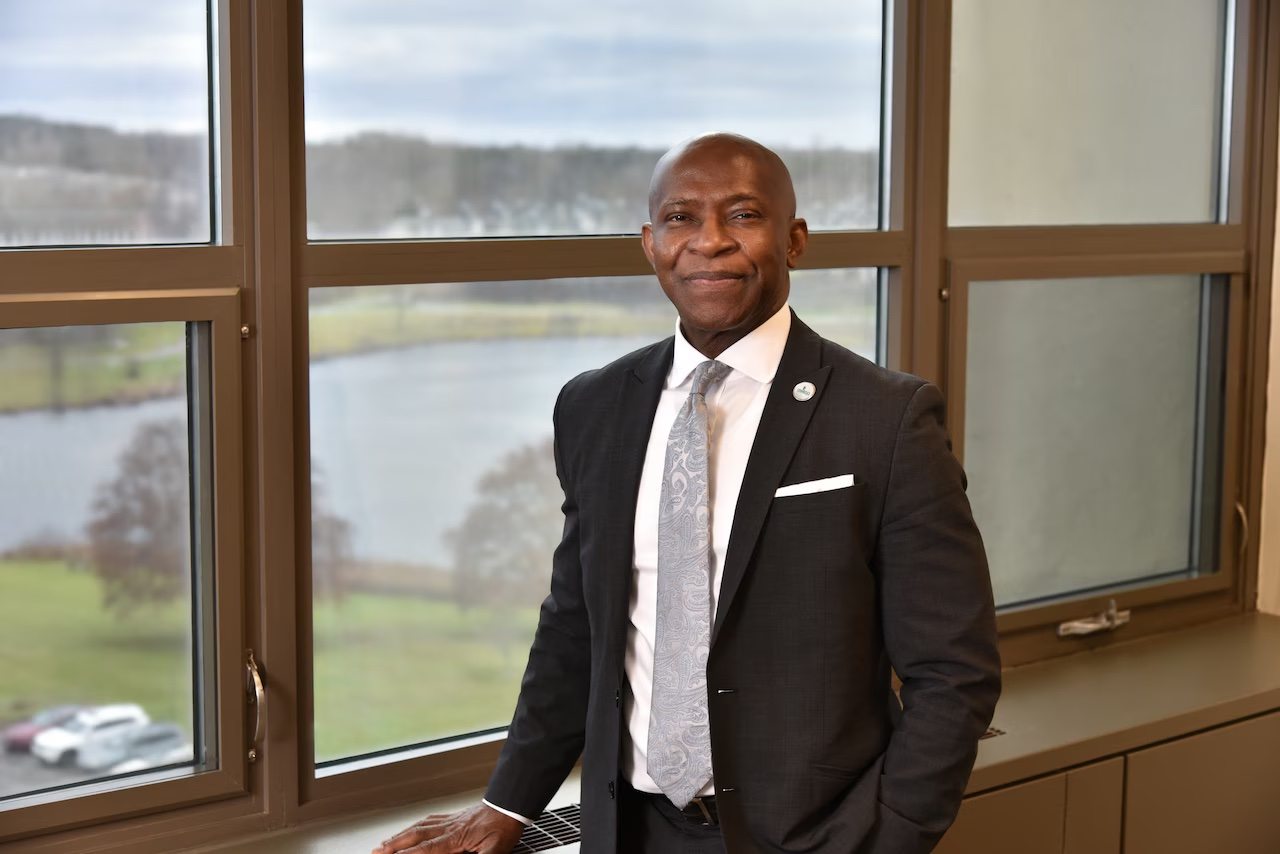
Peter O. Nwosu, Ph.D., took office as the 11th president of SUNY Oswego in mid-August. At the end of September, Nwosu announced an ambitious vision for the university that calls for doubling the number of graduates to 4,000 a year by 2040.
Not all of those graduates would leave Oswego with a four-year degree. Nwosu envisions granting stackable “microcredentials” for in-demand jobs at Micron and the Port of Oswego; attracting more international students; reengaging students who stopped short of a diploma; boosting SUNY Oswego’s presence in downtown Syracuse; and persuading more local high school graduates that college is worth it.
Despite the demographic and financial headwinds buffeting higher education, Nwosu sees Oswego as a vital engine of social mobility and regional economic development. “If we sit back and do nothing, then we lose out on what that renaissance might mean for us,” the president says.
Nwosu (the “n” is silent) grew up in post-civil war Nigeria. He was the first in his family to go to college, where he studied journalism. A year of compulsory national service led to a job at the World Bank and encouragement from a mentor to study in the United States.
Nwosu earned advanced degrees at Towson University in Maryland and Howard University in Washington, D.C. While still a student, he was recruited teach in the California state university system, where he served in a various faculty jobs. Nwosu later switched to administration, taking posts in California, Georgia, Tennessee, New York City and now the top job in Oswego. He also is a graduate of the Harvard Institutes for Higher Education.
Nwosu’s office atop Culkin Hall features a sweeping view of Lake Ontario and, under a clear plastic box, the scuffed leather shoes he was wearing when he first stepped on U.S. soil. They are a reminder of his journey from immigrant to college president, and the values that guided him along the way.
“If it wasn’t for those shoes, I certainly wouldn’t be able to even think of doing this work,” Nwosu says.
The president will touch on many of these themes in his second commencement address, to be delivered May 11 on campus. Our conversation has been edited for length and clarity.
What drew you to the United States in the first place?
Nigeria went through a major civil war. That has informed my values about conflicts. My parents told us those stories, and we saw them, including the [bullet-pocked] elementary school that I went to … My parents lost all they had. A modest income family became almost a poor family because of the consequences of that experience. They worked to ensure that their kids went to elementary school, went to high school and went to college. I was the first in my family to attain a college education.
That war allowed for a graduate from any of Nigeria’s institutions of higher education to participate in a mandatory national service [like the Peace Corps here]. … I was fortunate to land in a World Bank project. At the end of it, they hired me. The head of the unit asked me: What do you want to do with your life? I said, I want to continue my education. He said: What’s holding you? I said, my background. … I ended up, with his approval, coming to the United States and getting funding to pursue my graduate work. And so here was this poor kid with this great opportunity.
Coming to the United States exposed me to additional opportunities that I never really knew existed.
You’ve already laid out a bold agenda: to double the number of graduates from 2,000 to 4,000 by 2040. What is driving that number, when many colleges are saying, we don’t have enough students to fill our classes?
As a leader, if you don’t think creatively about how you address the challenges that are facing us, and we will face down the road, then, of course, we’re just folding our hands. … Yes, there’s a decline in enrollment, what folks have called the “enrollment cliff.” The decline in birth rates is one big factor, but also there is this perception about the value of a college education. If you look at the work that regional comprehensives [like SUNY Oswego] do, … we’re well-positioned to set that ambitious agenda.
There’s also the other side of the decline in birth rate — an aging population. It has significant implications for our workforce, our economy, it also has implications for the vibrancy of our democracy. Young people are so vital to the sustenance and maintenance of our economy and a democratic society.
As a nation of immigrants, we’ve always replenished our population, never mind the noise that we hear today. Some will come and stay, some will go back to their countries. But either way, they are contributing to making this place a more vibrant society. Those who choose to go back are going back to build a global middle class that is equally important for our role as the world’s indispensable nation. If their societies are doing well … ultimately, it benefits all of us.
Micron will have implications for the additional jobs that will be created here. That’s significant here at Oswego. We have the Oswego Port Authority. … There are a number of other industries that are coming into this area. One begets the other. The role of a regional comprehensive, like ours, is to be able to provide the talent needed for those industries that are emerging to thrive. … If we sit back and do nothing, then we lose out on what that renaissance might mean for us.
You come in here with big ideas. How do you lead an organization, especially one as large as this one, through a big change?
Maybe they’re lying to me, but they have really embraced the vision because of the way that we crafted it and the process through which it came about, including not just our internal community, but external stakeholders, as well. [Rattles off a who’s who of business and political leadership in Central New York.]
We have an opportunity here because of our location. Things happening around us may not be happening in other areas where we have regional comprehensives. I’ve referred to us as the most mission-critical public comprehensive university in greater Central New York. I believe that significantly, because of the comprehensiveness of our offerings. The 400-acre Rice Creek Field Station does tremendous work on biodiversity. This lake allows us to study atmospheric work, given the change in climate.
It also takes time to get people [on board], so you have to build that into the planning process and your thought process.
You just don’t make that announcement and stop talking about it. You’ve got to keep at it, and remind people why this is important, why it is, what it is. You are the cheerleader. You are also the explainer-in-chief. You pull your team into that role, as well. And then you engage them, involve them in making those decisions.
I’m guided by the African proverb: If you want to go fast, go alone. If you want to go far, go together.
What do your students need to do to become good leaders?
Keep learning. Professional development is an ongoing process. Even for me, I go to these meetings not because I think I know everything, but because I don’t.
Recognize that collaboration is key. … You realize when you join an organization, you have to be a team leader.
Be open to new innovations. Sometimes they go away, sometimes they don’t. But they have implications for us. … Part of my goal is to make this place an AI [artificial intelligence] campus. That’s the world we live in.
Be involved. Offer yourself. Volunteer in your community, in your job … You have to ask, what is my contribution to making this place a better world than I inherited? … We all are here as temporary tenants.
You have fresh eyes on Central New York. What do you see that we don’t?
What struck me was the data about the educational attainment rate, not just in our county, but throughout Central New York in the five counties. [According to the U.S. Census Bureau, 20.5% of Oswego County’s population holds a bachelor’s degree or higher. In Onondaga County, it’s 39.1%.] I wasn’t particularly surprised that we have an educational attainment [problem but] I was surprised by the depth of it. The question for me, then, is how do we reverse it?
That’s what my colleague, OCC president [Warren Hilton], is doing. We’re very close in our work together. [Earlier this year, SUNY Oswego partnered with Cayuga, Jefferson, and Onondaga Community Colleges to facilitate seamless transfer.]
How do we create a college-going culture? I shared that with our school superintendent. We have work to do. I know that there are opportunities here that are emerging that will change this place. We have to be prepared to leverage those opportunities, to prepare folks, but we also we have to be able to attract people to come to Central New York.
How would you sell Central New York to somebody thinking of coming here?
Students will say, well, I came here because of XYZ but then they graduate, and they leave. But the opportunities that are coming in will help keep some of them here.
We’re all in this together. There’s not a single opportunity that comes I don’t speak about selling Central New York.
We also are partners with a number of entities here. … We lead the Oswego County migrant steering committee. We are in Syracuse; a task force is looking at reimagining that campus.
We’re also looking at microcredentials and stackable credentials. It is conceivable that a young man or woman will come here, they get a certificate in advanced manufacturing, they go work for Micron. A year or two down the road, they may decide to come back to get another certificate. … The second one builds on the first, and it’s building them toward a bachelor’s degree.
What’s the best advice a boss or mentor ever gave to you?
[The late] Professor Francis Idachaba was the head of that World Bank project. He was a professor of Agricultural Economics at the University of Ibadan, Nigeria. He moved on to become adviser to the president of Nigeria and then became president of a university. I have tremendous regard for him. But for him, I wouldn’t be here. He said: When you get there, take advantage of all of the opportunities an American education offers, and be the best at it. And that’s what I also tell our students, take advantage of what an institution offers.
Do not just walk through a place, have the place also walk through you. That was something that I learned from my professor at Howard University who I also hold very dearly, Bill Starosta, who was the first recipient of the Ph.D. in intercultural communication in the United States.
In other words, don’t be a slave to where you come from. Embrace the new place and become the new person. … Finding a balance between the two makes you a much better person, and in a multicultural society, you need to be able to become the new person, the transcultural individual. Otherwise, you’d be you become a prisoner in your space.
Five habits for success
At a CenterState CEO event in September, SUNY Oswego President Peter Nwosu shared some of his habits for success:
- Lead with your values. Be humble. We’ve all come to our roles in our own pair of shoes. Remember your leadership journey and use that story to inspire your team and motivate others.
- Lead with collaboration. Always engage others. Remember the African proverb: “If you want to go fast, go alone. If you want to go far, go together.”
- Reframe problems to be solved as opportunities to improve. Do your homework. Gather all the data and anecdotal evidence you need before making big decisions.
- Be seen. Make the time and show up at events. Drop in on meetings and gatherings. Get lunch in the cafeteria. Make unexpected visits to your facilities and workplaces and meet people.
- Take care of your physical and mental health. Exercise, stay hydrated, get enough rest.