
SUNY expands ACE student support program; Oswego remains largest in system
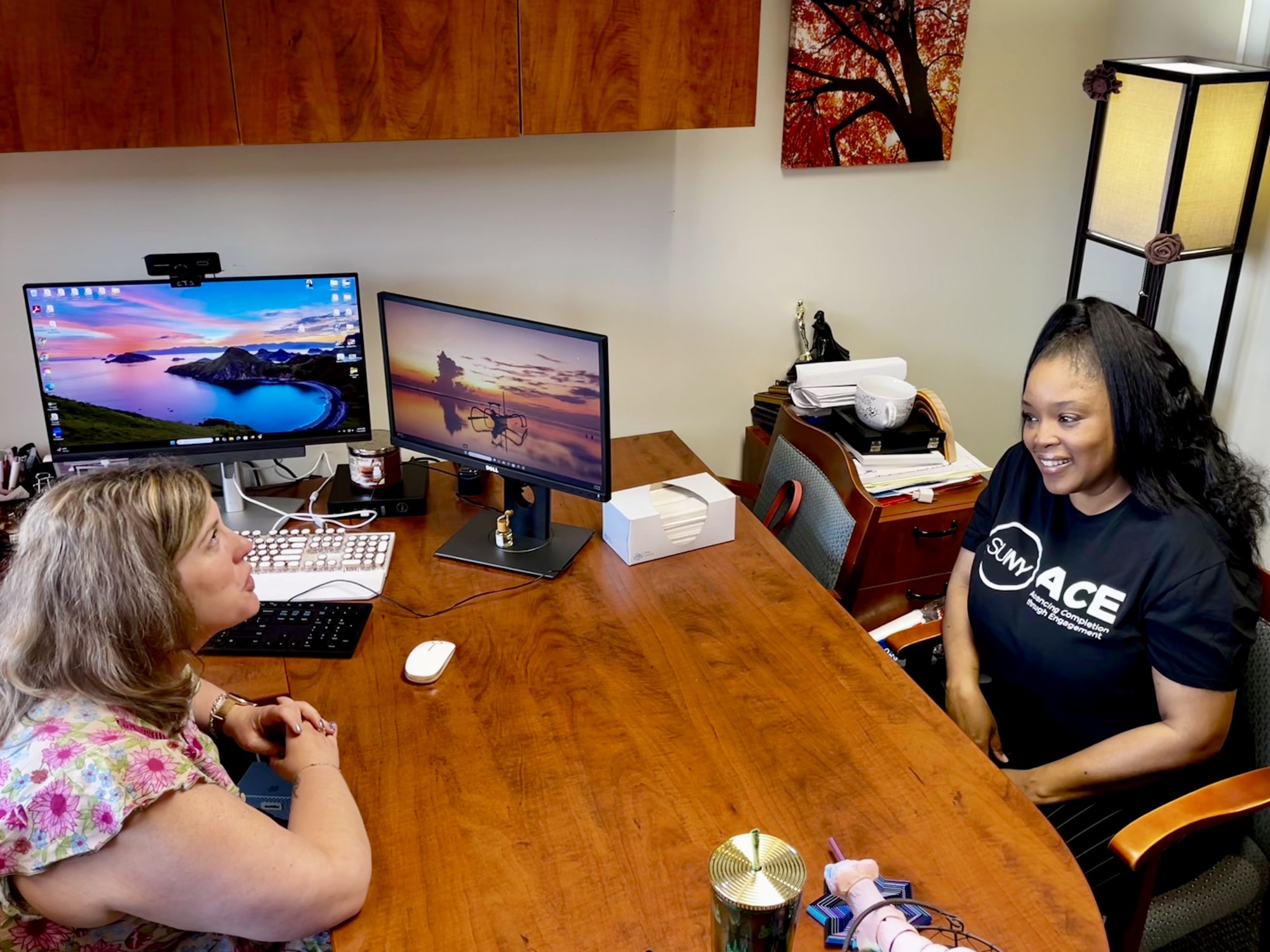
SUNY Oswego communications major and Advancing Completion through Engagement (ACE) student Melinda McCarthy (right) speaks with advisor Megan Runge in the Advisement Center. McCarthy said ACE provided crucial support in returning to school, and thriving, at SUNY Oswego.
Over the summer, SUNY Oswego celebrated the expansion of SUNY’s Advancing Completion through Engagement (ACE) program, for which Oswego remains the biggest program in the state system.
Together, through ACE for four-year schools and the Advancing Success in Associate Pathways (ASAP) program for community colleges, this initiative represents the nation’s leading college retention and completion models – serving 10,000 students at 44 SUNY campuses by the fall 2026 semester.
Around 490 of those students are part of SUNY Oswego’s program, once again making it the largest cohort of any campus in the system. As ACE student Melinda McCarthy notes, it makes a difference for each and every participant.
“What stood out to me most was the people,” said McCarthy. “It wasn't just my assigned counselor. The entire ACE team took the time to learn my name, check in on me and make sure I knew where to turn if I needed help. That genuine warmth, guidance and understanding made a tremendous difference. I never felt like just another student. I felt seen, supported and encouraged to succeed.”
SUNY created the ASAP and ACE program to help students gain and maintain academic momentum so they can graduate on time. Eligible students have access to a wide array of resources and support to help them overcome barriers that can prevent them from obtaining a degree. This includes funding to cover textbooks, groceries, transportation and other costs of attendance, as well as comprehensive personalized advisement, academic support and career development activities.
“ACE played an important role in helping me transition into this new chapter of my life,” McCarthy said. “Returning to college as a nontraditional student can feel intimidating, especially when you're starting over in a new environment. I began my journey in the middle of winter, when it can be harder to meet people and build a sense of community, but ACE made the campus feel welcoming from the very beginning.“
McCarthy praised ACE for creating opportunities to connect that feel natural, whether through events or shared experiences.
“Those activities helped remove many of the barriers that students often face when trying to find their place on campus,” McCarthy said. “Having that sense of community and knowing there were people invested in my success gave me the confidence to focus more fully on my academics and my goals.”
Investing in the future
Similar to how the ACE and ASAP programs are an investment in the future by supporting students, McCarthy’s journey back to school to major in communications was about investing in more opportunities while seeking more personally and professionally. For that reinvention, SUNY Oswego proved a welcoming and beneficial destination.
“When I was deciding where to attend, I had been accepted to multiple schools, but SUNY Oswego stood out because of the experience I had with the Admissions team,” McCarthy said. “Their responsiveness, professionalism and genuine willingness to help left a lasting first impression. It reminded me that how people make you feel matters, and it gave me confidence that this was a place where I could succeed.”
McCarthy also wanted the full college experience, especially all that SUNY Oswego has to offer.
“Earlier in life, responsibilities prevented me from living on campus or immersing myself in college life,” McCarthy said. “I decided that if I was going to start this new chapter, I wanted to experience it fully. Living on campus has challenged me to step outside my comfort zone, build new relationships and embrace opportunities I never had the chance to experience before. Looking back, it was one of the best decisions I've ever made.”
The positive experiences of ACE and the university in general led to McCarthy wanting to be an ACE peer mentor to support and help guide others. McCarthy called it “a meaningful accomplishment” that “represents an opportunity to give back to a program that invested so much in my success while helping other students navigate their own transitions.”
“After experiencing firsthand how much the program had done for me, I realized many students either weren't aware of ACE or didn't fully understand everything it has to offer,” McCarthy said. “That made me want to become part of the team and help spread the word.”
McCarthy knows firsthand that, whether one is an incoming first-year student leaving home for the first time or another non-traditional student stepping out of their comfort zone, starting can feel overwhelming. But the personal connections can help make it navigable.
“Sometimes all it takes is one person who listens, encourages you and points you toward the right resources,” McCarthy said. “If I can help another student feel welcomed, supported and confident enough to keep moving forward, then I'll know I've made a difference. Being able to pay forward the encouragement I received is both an honor and a responsibility that I take seriously.”
McCarthy also wants to serve as an example that it’s never too late to reinvent yourself, and that success isn’t determined by age, background or where one began the journey.
“ACE didn't reinvent my life for me,” McCarthy said. “It gave me the support, resources and confidence to reinvent it myself. I would wholeheartedly recommend the program to every student who is eligible because it provides far more than academic support. It creates a community where students know they belong and have the tools they need to succeed.“
Increased state support
The expansion of the ACE and ASAP programs was made possible through an additional $8 million in allocated funding in the 2026-27 enacted state budget, bringing the total state investment in this successful program to $20 million annually.
“SUNY is committed to the success of every student, and the continued expansion of ASAP|ACE will help ensure our students can complete their degree on time, achieve their dreams, and move forward on a path to upward mobility,” said SUNY Chancellor John B. King Jr.
“I am thrilled that through the support of Governor Kathy Hochul and the State Legislature, and for the SUNY Board of Trustees, these vital programs will serve 10,000 students across the state this fall and I thank the SUNY Oswego administration, faculty and staff for their unwavering commitment to student success,” Chancellor King added.
For more information about the ACE program at SUNY Oswego, visit oswego.edu/ace.