
SUNY Chancellor’s visit tours sustainability investments advancing geothermal energy
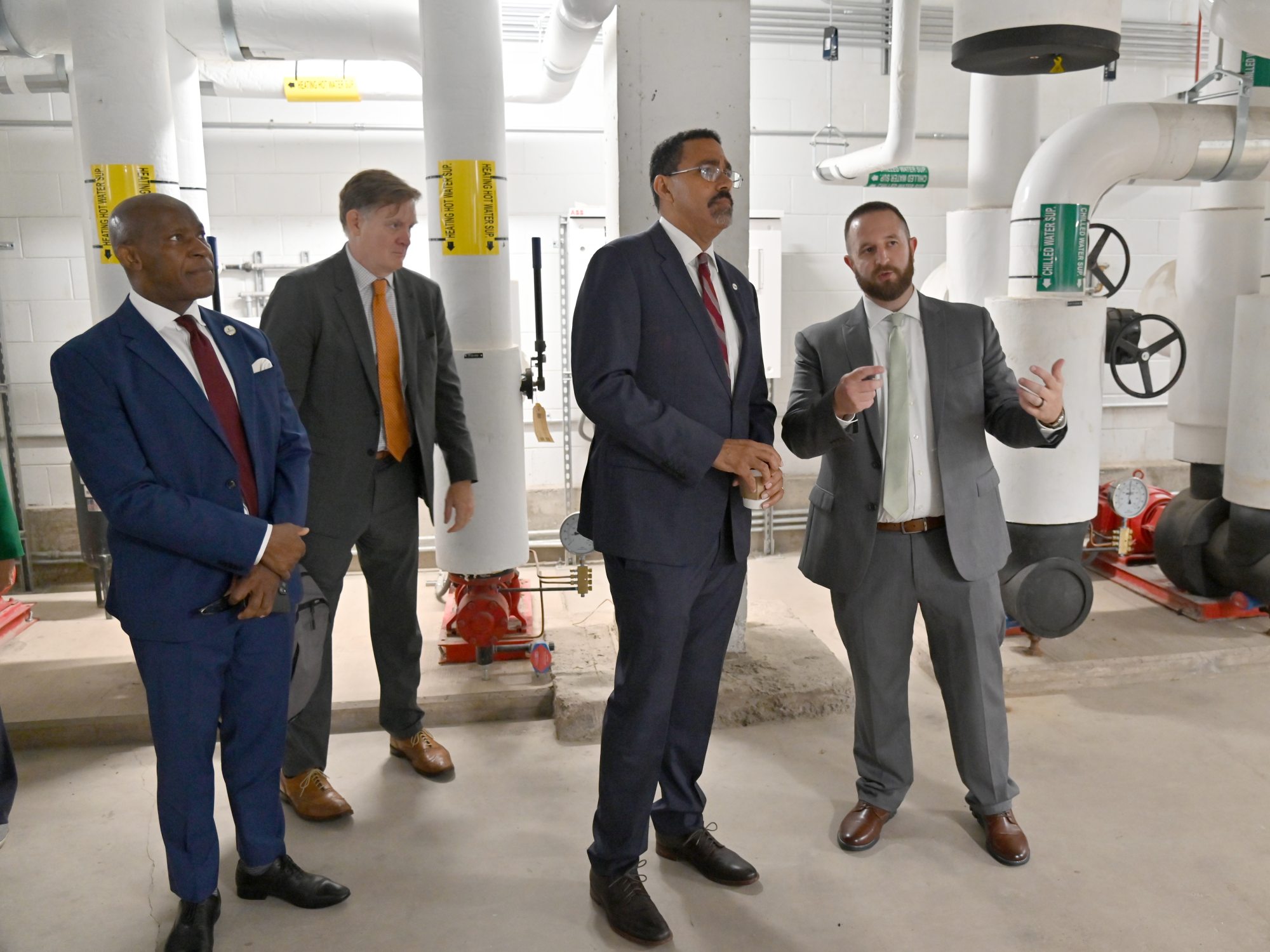
SUNY Chancellor John B. King Jr. (second from right) listens to SUNY Oswego Director of Capital Projects Devin Reese explain some of the geothermal features underneath Hewitt Hall during a recent visit on Aug. 19. Listening from left are SUNY Oswego President Peter O. Nwosu and SUNY Chief Sustainability Officer Carter Strickland.
State University of New York Chancellor John B. King Jr. highlighted SUNY's climate and sustainability excellence and investments being made to reduce energy use during an Aug. 19 visit to campus.
During a visit to SUNY Oswego's Hewitt Hall, Chancellor King reviewed work to expand usage of geothermal systems to provide renewable energy to the facilities within the building. Chancellor King, SUNY Oswego President Peter O. Nwosu, SUNY Chief Sustainability Officer Carter Strickland examimed current geothermal well drilling and campus plans to implement geothermal energy during other renovation and construction projects.
The tour, led by Assistant Vice President for Facilities Services Mitch Fields and Director of Capital Projects Devin Reese, showcased some of the facilities currently helping the renovated Hewitt Hall operate at a 48 percent reduction in its site annual energy consumption, with a much larger percentage of sustainable energy and much smaller carbon footprint.
Across SUNY's state-operated campuses, greenhouse emissions from on-site, purchased energy, and fleet vehicles have been reduced by over 40 percent compared to 1990 levels, and at SUNY Oswego they have gone down by over 45 percent.
"SUNY is committed to helping build a sustainable and resilient future for New York State and to serving as a leader in climate protection and advancing green technology,” said SUNY Chancellor King. “System-wide, SUNY is working to make capital improvements that modernize facilities, reduce fossil fuel usage, and help the state meet climate sustainability goals. With strong support from Governor Kathy Hochul and the State Legislature, SUNY can be an example to the rest of the nation on how meaningful investments can lead to long-term savings and climate resiliency.”
Showcasing sustainability
The renovation of SUNY Oswego's Hewitt Hall began in 2021, and the building was reopened in August 2025. Hewitt Hall houses SUNY Oswego's School of Communication, Media and the Arts, and renovations were made possible by $80 million in funding from New York State through the SUNY Construction Fund.
In addition to the renovations to the studios, labs and other facilities in the building, Hewitt Hall also serves as a model geothermal system that provides renewable energy to the building. This efficiency is driven by a dedicated geothermal field featuring 90 six-inch boreholes drilled 500 feet deep each. The related operation required 8.5 miles of drilling to install 18.8 miles of piping.
A $30 million climate resiliency grant, allocated by Governor Hochul from the Clean Water, Clean Air and Green Jobs Environmental Bond Act, is extending this work through a thermal network to Mahar Hall, Culkin Hall, the Penfield Library and Lanigan Hall renovations, which will allow those projects to incorporate geothermal technology.
"We have made sustainability and renewable energy a strategic priority as we renew and modernize our facilities and infrastructure because it strengthens our campus, our region and New York state,” President Nwosu said.
“By reducing our reliance on fossil fuels, improving efficiency and lowering our carbon footprint, we are making investments that deliver long-term environmental and economic benefits while enhancing the educational experience for our students,” President Nwosu noted. “We appreciate SUNY and New York State for their partnership in advancing our commitment to advancing a more resilient and sustainable future for our region and New York."
Geothermal systems transfer heat both to and from the ground, maintaining a relatively constant year-round temperature. A buried loop of fluid-filled pipes extract heat from the earth to warm buildings in winter while cooling buildings in the summer by transferring indoor heat back into the ground. The closed-loop system connects to a heat pump and distribution network to deliver conditioned air or water through facilities via ducts or radiant heating.
Currently, 23 campuses across the SUNY system use geothermal systems, often on a building-by-building approach. Thermal energy networks, like at SUNY Oswego, are even more efficient because their piping systems tie together multiple buildings that can exchange heating and cooling. In addition to using the consistent temperature of the earth, such networks can also blend multiple thermal sources and use wasted heat from cooling towers, wastewater effluent, data centers, and other sources.
Over the past three years, New York State has invested $230 million to build out thermal energy networks at SUNY campuses.