
Oswego student’s monarch butterfly tracking project takes flight internationally
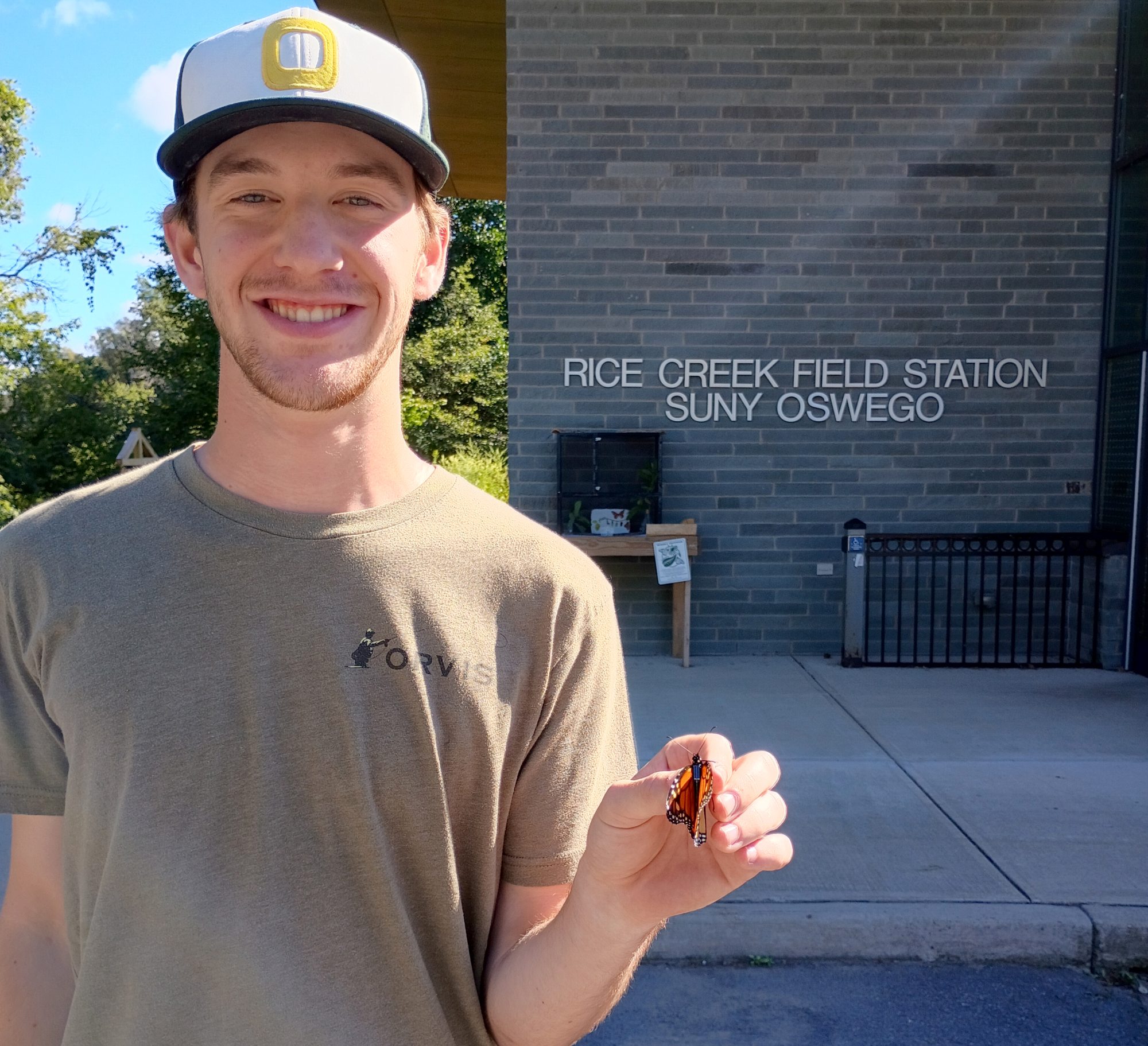
Zoology major Dashel Hiller holds RCFS01, both the first monarch butterfly he tagged with a cutting-edge tracking device and the first participant to successfully migrate to Mexico as part of SUNY Oswego's participation in the groundbreaking Project Monarch Science.
On Oct. 17, a migrating monarch butterfly crossed the border into Mexico, marking a landmark achievement for SUNY Oswego zoology major Dashel Hiller some 2,000 miles away.
Hiller caught this butterfly at the university’s Rice Creek Field Station on Aug. 28, attached a tracking radio tag to it and then watched its progress – along with many others – via the Project Monarch Science app.
The international traveler, known as RCFS01 as the first butterfly Hiller tagged, is one of 20 butterflies he equipped with newly developed BlūMorpho tags from Cellular Tracking Technologies, which runs the app and the project in partnership with the Cape May Point Arts and Science Center. These tags are the lightest on the market, weighing less than a grain of rice and consisting of only a tiny solar panel and an antenna the size of a sewing needle.
"I'm looking to see: How are they migrating? Where are they going? Are they using more urban areas? Are these in more rural areas? Where are they migrating on the U.S.? Where do they go after leaving Oswego?” Hiller explained.
After the first success, just days later a second butterfly, RCFS07 as the seventh tagged, traveled via a more direct route to make it to Mexico, home of an overwintering site first discovered in the 1970s. RCFS19 has since joined them via a more circuitious route.
“I've been interested in butterflies from a young age,” said Hiller, for whom zoology is sort of the family business. His father is a wildlife biologist for Bemidji State University in Minnesota, and his older twin siblings – Casey and Zane – graduated from SUNY Oswego in May after gaining plentiful research experience at Rice Creek and elsewhere.
“I saw how much they were doing here and the opportunities that they had, and I just thought, wow, this is an amazing place to be,” Dashel Hiller recalled. “There are so many opportunities for research, and I'm a huge fisherman, and so the location on the Oswego River also pulled me in.”
Hiller started following in his brothers’ footsteps almost immediately after arriving at Oswego, working with Daniel Baldassarre of the biological sciences faculty. Hiller, who said he has been banding birds under professional supervision – to equip them for tracking – since he was 8 years old, got involved in this at Rice Creek Field Station as well. He also had experience capturing and putting sticker tags on monarch butterflies since 2018, estimating tagging around 700.
Then one day, Baldassarre asked Hiller, “Hey, have you seen these?” and sent information on the new advanced and light radio tags, Hiller said. “And he sent me a picture of them,” Hiller said. “I was like, man, those are sweet.”
Hiller then approached Karen Sime, director of Rice Creek Field Station and a biological sciences faculty member who has similar interests.
“The technology is really new,” Sime said. “Last fall was the first time it was deployed. Dashel noticed it and asked if we can do this."
Hiller then did the research, writing Cellular Tracking Technologies to learn what the tags cost. At $200 apiece, and with a goal for 20 tags, Sime and Hiller then worked on successfully receiving funding through grant applications – $3,000 for Rice Creek Associates (RCA) Small Grants project and another $1,000 from a campus Student Scholarly and Creative Activities Grant.
Hiller took it from there, but didn’t do it alone – enlisting the help of the Zoology Club, which he is president of, as well as an interested community already engaged with Baldassarre’s bird-banding events. As a result, this citizen science project involved campus and community members of all ages as participants or spectators of the delicate tagging process.
Sime compliments Hiller and the others involved for making this a truly public science educational project that embodies what Rice Creek and the university stand for.
“We’ve known from the start this tagging project would have a lot of educational value but it’s also something where a lot of people can get into it,” Sime said. “It works well for doing it at Rice Creek because we have public events. Dashel is able to piggyback on that, and it brought in more people to participate or watch.”
Rice Creek, which Hiller describes as “a true hidden gem,” has been a fundamental resource for this project.
“Without it, I probably wouldn't be able to do this project, between the RCA funding and the ongoing support of the RCA, the support of Rice Creek faculty and the workers letting me in after hours to get their tags, tolerating me being there every day,” Hiller said.
Following the butterflies
SUNY Oswego appears to be the only site in Upstate New York participating in the project, chronicling this important first part of the journey, and joins around 50 other research organizations that are just starting to put pieces of this giant migratory puzzle together.
Little is known about the migration routes of monarch butterflies, and why they fly where they do, so this study breaks new ground in finding answers – and raising additional questions to be studied.
“We knew that butterflies from New York go to Mexico but didn’t know how they got there, how long it took them, but now we can watch them in real time – where they go, how long they rest in one location, how weather patterns affect them,” Sime said. “The result is a really detailed picture of how these things are.”
Sometimes this comes with surprising results.
“We had four of them travel over Lake Ontario, which was pretty shocking,” Hiller said. “I remember seeing it, and I texted Dr. Sime, and I was like, ‘What the heck is going on?’ And she thought they just picked up on a Canadian cell tower or something. From an energy standpoint, there's nothing to land on, and there’s no way to recharge. I believe the tailwind was only about two miles an hour. So it wasn't like they were being pushed over the lake.”
One of the last butterflies tagged in Oswego, RCFS19, also took a curious route, noted by Cellular Tracking Technologies in an animated Facebook post looking at a group of five tracked butterflies making an unexpected and ambitious journey -- the first ever documented crossing the Gulf of Mexico.
"RCFS19, tagged Sept. 30 at Rice Creek Field Station in Oswego, New York, left the Florida Panhandle on Oct. 21 and was heard Oct. 24 on the Rio Grande, right at the border between Brownsville and Matamoros: about 1,230 km in 67 hours," the post said.
In a separate post, Sime noted: “RCFS01 and RCFS19 are pretty close to each other now at roughly the same latitude, and both have traveled some 2000 miles from Oswego. But It took RCFS01 56 days to get to this point, and RCFS19 took only 23 days. Wild!”
Another wild development has been the amount of attention the project – including Oswego’s involvement posted on Rice Creek’s Facebook page – have attracted, appearing across feeds of people not even connected to the field station or campus but fascinating in the project.
Sime also reported two media outlets had reached out because of the posts, but adding the wide interest and community involvement stem from Hiller’s enthusiasm and ability to communicate this important science project.
“He does a wonderful job of showing the science, and letting people participate just enough in the right ways,” Sime said. “Having that at Rice Creek makes that easier, as we have a network, we have events and we have the social media presence with a lot of followers.”
Hiller’s work is getting recognized outside the science community as well, as this project and his presentation won the Best Paper Award at the recent SUNY Oswego Leadership, Innovation and Development (SOLID) Conference.
Just beginning
Even as some butterflies reach their winter homes in Mexico, while others continue their flights, the successful first year at SUNY Oswego marks just the beginning of this and related projects made possible by Hiller, other interested students and the Rice Creek Field Station facilities.
Another student, Andres Valdivieso, started conducting related research over the summer on monarch rearing, how to help these butterflies start their lifecycles in the best way possible.
“He did some wonderful work over the summer, so I plan on working with him this summer to do a more widespread rearing project to figure out how we can more properly rear them to make sure they make it,” Hiller said.
As a sophomore, Hiller hopes to continue to earn the same grants, while seeking out additional funders, for at least another two years to increase the sample size and collect more and more data to develop a bigger picture to solve this migratory mystery.
“What's fascinating is we find completely different migratory patterns,” Hiller said. “We want to figure out what does it have to do with weather and everything else? There are a lot of variables and a lot of different routes. Like RCFSO1 went up to Wisconsin before making it to Mexico. And then RCFS 19 going down to Florida, along the East Coast. They're going wildly opposite routes, and we've had some go through the middle, but it's just been amazing to watch how different storms have affected them.”
Hiller praised the app as easy to use and with a backend dashboard that even allows seeing how many people are tracking any butterfly at any time -- showing the wide impact of this project.
"Sometimes I'll go and look at each of my monarchs and think, wow, there are 70 followers -- like, who is following this?" Hiller said. "It's been amazing to see the community support of just random people I don't even know just following this so invested. It's been awesome."
As a participant and observer, Sime is pleased to be part of it.
“Rice Creek is a huge facilitator of research,” Sime said. “It’s actually unusual to have a field station associated with a college and so close to it. At Rice Creek, students can take a bus or a bike here and do research when they have the time.”
Becoming director of Rice Creek within the past year, Sime has been especially proud of how the students, faculty, community and facility actively work on environmental and ecological research, outreach and problem-solving.
“I’ve been impressed that there’s good funding for student work, especially the grants I work with students on,” Sime said. “If the students work with their faculty mentors on support, they can find what they need to do a summer or semester-long project. There’s a fair amount of research that can happen here because of the various habitats.”
For Hiller, support ranging from his family to SUNY Oswego faculty and students have been crucial along the way.
“Dr. Sime and Dr. Baldassarre have been nothing but supportive,” Hiller said. “Dr. Sime has been out there with me in the field, helping me catch butterflies, helping me tag them, just doing everything she can. Dr. Baldassarre came to a bunch of taggings, helped me tag a few, and he's also done a wonderful job, promoting it on RCBO Birds, the Rice Creek Bird Observatory (@rcbobirds) on Instagram. I can't thank them enough. I truly wouldn't be able to do it without them.”
Anybody can follow the progress of Oswego’s 20 tagged butterflies via the Project Monarch Science app (available on Apple and Google Play), filtering for "SUNY Oswego" to see the local travelers specifically and by clicking on an individual butterfly to reveal their flight path.