
Faculty member Bella Poynton's new play at Oswego probes humanity-technology intersections
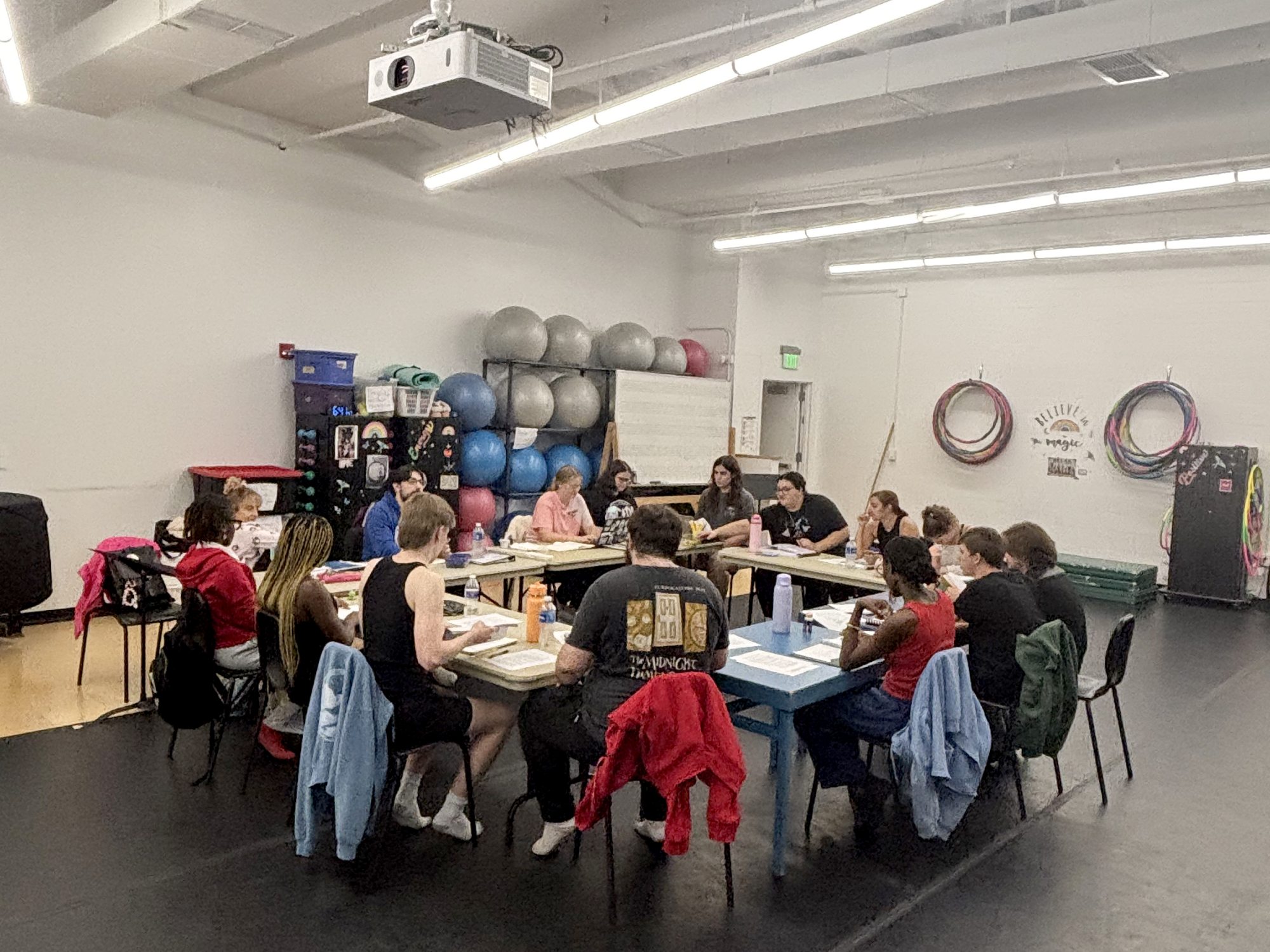
The cast and crew of "The Appliance Department" take part in an early reading and discussion for the new play from faculty member Bella Poynton. (Photo by Anni Foster)
As students prepare to bring robotic companions to life in Waterman Theatre in this fall's theatre production of “The Appliance Department,” the playwright who imagined them works in Tyler Hall as well.
For Bella Poynton, now three years into her time at SUNY Oswego, staging the new play on campus brings together two sides of her career that don’t always get to merge: playwright and professor.
A playwright, dramaturg and theatre historian, Poynton came to Oswego with a career already rooted in asking unconventional questions. Her work frequently intersected theatre with science fiction, technology and robots, all things uncommon in traditional theatre.
“The Appliance Department” is no exception.
This science-fiction play follows robotic companions confronting one of humanity's biggest questions: what does it mean to be human? These companions question family freedom and autonomy, reflecting questions Poynton has explored throughout her career.
Her doctoral dissertation examined robotics in theatrical performances, tracing representation of robots to the 1920s. Rather than returning to the familiar image of robots as villains, Poynton is interested in what happens when a story considers their perspective. Poynton was ready for a different story. That perspective became central to “The Appliance Department.”
“Personhood is the experience of having memory and feeling and autonomy and agency and wanting things,” said Poynton. “But, that doesn't necessarily mean that you always have to be human.”
The characters' opposing desires create tension between belonging and having autonomy. In other words, the desire to be wanted, but on your own terms, not on others'.
“There’s a balance between what we want, how we want to be wanted, and the freedom that we realize we actually need,” Poynton said.
Career built on curiosity
Poynton began writing plays when she was just 8 years old. Growing up around conversations about life and art, she remembers wanting to participate even before she was old enough to fully understand them. That same curiosity has carried over into her career.
“I’m fascinated by what can be achieved between two people in a conversation,” Poynton said. “What can they achieve by talking about their ideas?”
With that same fascination, today she helps create those conversations with another generation of artists.
“I think I know the students are having a great time and I know that the people are enjoying working on it,” said Poynton. “For me as faculty, that’s the most important thing, and I’m getting a lot out of it.”
New opportunity for students
It’s a unique experience, as students aren’t simply working from a finished script written by someone they have never met. Poynton is in the rehearsal room as the work continues to evolve.
“It’s important that we give students that exposure to working with a playwright who’s like, ‘I think I need to change this line,’” Poynton said. “Being in the room when that happens and having the student name on the play is very unique.”
Tara Turton, a sophomore theatre major from Queens who plays Violet, one of the leading characters, agrees.
“It's been so enjoyable working with Bella and being in the room when she makes those changes,” said Turton. “She is so supportive, I love her…working with her is really, really fun.”
Her work with robots, artificial intelligence and science fiction pushes against theatrical convention. She doesn't pretend to have all the answers. Instead, her work asks audiences and students to sit with questions that don't necessarily have simple conclusions.
“I think that robots are such a fascinating object because they are an extension of us,” Poynton said. “We’re trying to recreate ourselves in the robot, and it winds up not being quite us.”
Bringing it all together
At Oswego, those experiences have become part of her mission as an educator: to give students the opportunities to see that theatre isn't simply something inherited from the past. It is something they can actively question, reshape, and create together.
Poynton describes her experience at Oswego as one of the best of her career.
“It's almost too good to be true,” Poynton said. “Across the board here at Oswego, we really are invested in each other's success in a way that I find not true in a lot of places…I've gotten to do awesome collaboration and everyone in the theatre department is amazing.”
Turton has had a similar experience; she came to college because she felt inspired by Broadway in high school. SUNY Oswego’s Theatre Department and faculty have only nourished that.
“Everyone is so friendly and encouraging…It’s really easy to work with everyone,” said Turton. “It’s my first play ever…I feel like my mind is out of the world. But I remind myself: this is why I'm here; I wouldn't be here if others didn't see that potential in me.
In three years, Poynton's curiosity about people, technology, and the art of storytelling has shown the rehearsal room and students alike how work on the stage constantly evolves. The next act is still being written.
“The Appliance Department” runs Oct. 14 to 16 at 7:30 p.m.; Oct. 17 at 2 and 7:30 p.m.; and Oct. 18 at 2 p.m., all in Tyler Hall’s Waterman Theatre.
Tickets are free for SUNY Oswego students, $12 for all others. Tickets and additional information are available on tickets.oswego.edu.
– Written by Jose Vazquez Nava of the Class of 2027