
Alumnus presents five things to know about AI -- and the human advantage
For some, what is called "artificial intelligence" may feel like something happening somewhere else — in Silicon Valley, inside technology companies or in the hands of people who understand a lot more about computers than you do.
But CNY-based serial entrepreneur Jeff Knauss, a 2007 SUNY Oswego graduate, has a different message: AI is already changing the way people work, and you don’t have to be a computer scientist to take part.
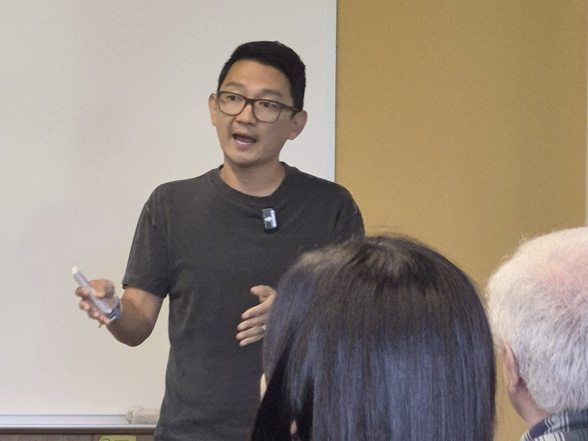
Speaking to College of Business and Entrepreneurship faculty during a pre-semester workshop in August, Knauss, founder of ArcovoAI in Syracuse and the former owner of digital marketing agency DigitalHive, offered a decidedly pragmatic view of the rapidly evolving technology.
His advice? Start learning.
“Start now so you don't get behind,” Knauss told the faculty.
That doesn’t necessarily mean becoming an expert in artificial intelligence. Instead, it means understanding how AI can change the way you approach your own work — and developing the distinctly human skills that become more valuable as technology takes on more routine tasks.
Here are five takeaways from his presentation.
1. AI isn’t just replacing jobs. It’s replacing tasks.
One of the biggest misconceptions about AI, Knauss said, is that its primary purpose is to eliminate jobs.
That may happen in some cases, Knauss acknowledged, but his experience working with hundreds of businesses suggests a more immediate and nuanced change: AI is taking over tasks rather than entire jobs.
“The administrative, repetitive, mundane” work is where AI can make the biggest difference, he said.
He offered a simple example using accounts payable.
An AI “agent” can retrieve an invoice, compare it with a purchase order, identify discrepancies, communicate with a vendor and organize information for payment. But a human can still make the final decision to actually pay the bill.
The result isn’t necessarily one fewer employee. Instead, someone who previously spent hours processing invoices can spend that time doing work that requires judgment, problem-solving or relationships.
Knauss said that distinction matters.
At one company, for example, an AI system reduced the time required to onboard a new advertising client from four to six weeks to about 40 minutes. The goal wasn’t to eliminate people. It was to allow them to begin serving the client sooner, generate revenue faster and spend more time on higher-value work.
For workers, the lesson is straightforward: look at your job as a collection of tasks, not a single job title. Which tasks could technology handle? And what could you do with the time it gives back?
2. The most valuable skills may be the ones AI can’t easily replicate.
If AI can increasingly handle spreadsheets, presentations, research and other technical tasks, what should people focus on?
Knauss has a list: critical thinking, problem-solving, communication, empathy, relationship-building, sound judgment and the ability to understand a process from beginning to end.
In fact, when hiring for his own company, he said he is less interested in whether someone can simply build something and more interested in whether they can solve a problem.
That shift has implications far beyond technology jobs.
A salesperson who understands how to use AI to identify prospects and prepare proposals has more time to build relationships. A communications professional who can use AI to automate routine work can spend more time thinking strategically. An accountant who can automate repetitive processes can focus more on advising clients.
And there is another human advantage: context.
AI may have access to enormous amounts of information, but it doesn't necessarily know the unwritten rules of a workplace — the vendor you've dealt with for 15 years, the customer relationship that requires special care or the reason a seemingly logical decision might create a problem.
“Humans have a full context,” Knauss said. “Agents will never have the full context.”
That accumulated experience and knowledge remains valuable.
3. You don’t have to be technical to become good at AI.
Knauss emphasized that you don’t need to learn how to code to benefit from AI, offering himself as evidence.
“I've never written a line of code in my life,” he said. Yet he has used AI to build websites and develop solutions for his businesses.
His advice for learning AI is simple: use it.
Rather than waiting for the perfect course, book or training program, start with something you actually need to accomplish.
Need to understand a complicated spreadsheet? Ask AI to explain it.
Need to learn how to create a website? Ask AI to walk you through it.
Need to organize a large amount of information? Give the tool the information and ask it to help you make sense of it.
In one example, Knauss described using AI to help create a website that would teach his children how to train their new dog. He supplied information he had already gathered, asked the AI to conduct additional research and then had it build a week-by-week learning site.
He emphasized the importance of learning by doing.
“Every day I use it. Every day I learn something new,” he said.
4. Don’t let AI do your thinking for you.
For all of his enthusiasm about AI, Knauss was equally emphatic about one danger: accepting AI output without thinking critically about it.
AI can produce something quickly. That doesn't mean it's correct, complete or appropriate.
In a world where AI can generate convincing text, images and video, the ability to distinguish fact from fiction becomes even more important. The same is true in the workplace. A polished AI-generated report can still contain errors. A seemingly reasonable recommendation can miss important context.
“Thank you for the help,” Knauss suggested as the appropriate mindset. “But now I need to use my reasoning, my critical thinking, my brain.”
Critical thinking, he said, is the No. 1 skill he believes people should develop for an AI-powered future. That may be one of the most important takeaways for anyone — whether you're 22 or 72.
While AI can make it easier to produce an answer, it doesn't eliminate the responsibility to decide whether the answer is a good one.
5. The best time to start learning is now — and it doesn’t have to be overwhelming.
AI is changing so quickly that trying to “master” it can feel impossible.
New tools appear constantly. The capabilities of existing tools change. Proponents of AI say that seemed futuristic a year ago can become commonplace in months.
While Knauss knows that can be intimidating, he offered a much more manageable approach: take small steps.
He suggested that someone who spent 15 minutes a day experimenting with AI could make significant progress. More ambitious learners could devote considerably more time.
The important thing is to start. And perhaps the most compelling reason isn't simply to keep up with technology. It's to remain adaptable.
When Knauss started his AI company, the way his team built and delivered its products changed repeatedly in a relatively short period. The pace of change, he said, means employers increasingly need people who can learn, adapt and figure things out as circumstances change.
That is a skill that has always mattered — long before AI.
The human advantage
For all the talk about artificial intelligence, perhaps the most human message from his presentation was this: the future isn't necessarily about becoming more like a machine.
It may be about becoming better at the things that make us human.
As AI takes on repetitive work, the human relationships, communication, empathy, judgment and creativity can become more — not less — important.
“Human relationships,” Knauss said, “will be one of the keys to the future.”
— Submitted by University Advancement