
Alumnus, HR pro cautions students that AI is a tool, not a solution
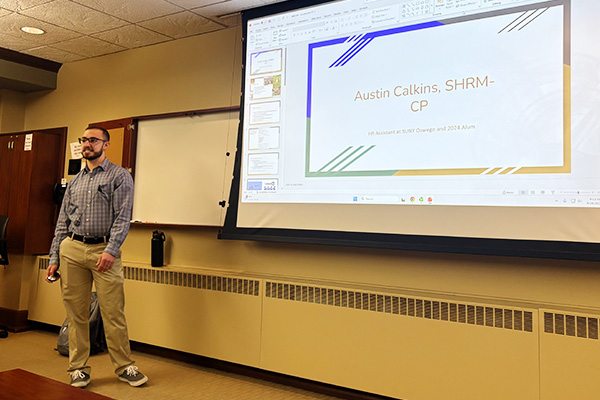
When Austin Calkins graduated from SUNY Oswego two years ago, "AI" (artificial intelligence) was seen as more of a novelty. Now, as a human resource generalist in the university’s Office of Human Resources, Calkins said it’s something every new graduate is expected to understand.
“For better or for worse, you’re gonna need to know your technology and AI,” Calkins told students in professor Steven Abraham’s "Human Resource Management" class.
The bigger issue, Calkins said, is who takes the blame when AI gets it wrong. One of the new union contracts at his workplace includes a section on AI, and Calkins summed up its message simply: “Humans are liable for the output.”
Calkins gave an example. "If you wrote an email and wrote, 'Hi,' and then in brackets, 'his name,' and then you didn’t fill in that name, it’s your fault. It’s not the AI’s fault.”
The stakes get higher when AI is used to make decisions about people. Calkins showed students a cartoon he made with Google Gemini, in which an AI tool flags an employee as a “high turnover risk.” She’s shown packing up her desk with a photo of her child. Calkins pointed out that New York State bans discrimination based on familial status, which could open the door to a lawsuit.
“The AI might have flagged her, but it’s [the] organization who made the decision,” he said.
AI also has blind spots that only people can fill.
“AI does not know context. You do,” Calkins said. "It may know HR best practices, but it doesn’t know a workplace’s unwritten rules or which departments have a rocky history."
He also won’t put employee names or data into AI tools. If that information leaked, he said, "It’d be no different than me shouting it to the world.”
Calkins compared AI to a GPS, pointing to the episode of "The Office" where Dwight drives into a lake because the GPS told him to.
“Don’t let AI drive the vehicle for you,” he said. “Use AI to help make informed decisions, not let it make decisions for you.”
Calkins’ message wasn’t so much a warning against AI as a reminder that people still own the results.
“You’re responsible for the accuracy, ethics and consequences with everything you produce,” he said. “You cannot pin the blame on AI. AI is a tool, not a solution.”
— Written by Lillian Haggerty of the Class of 2027 for University Advancement