
Alumnus delivers Sheldon Lecture, receives Presidential Medal
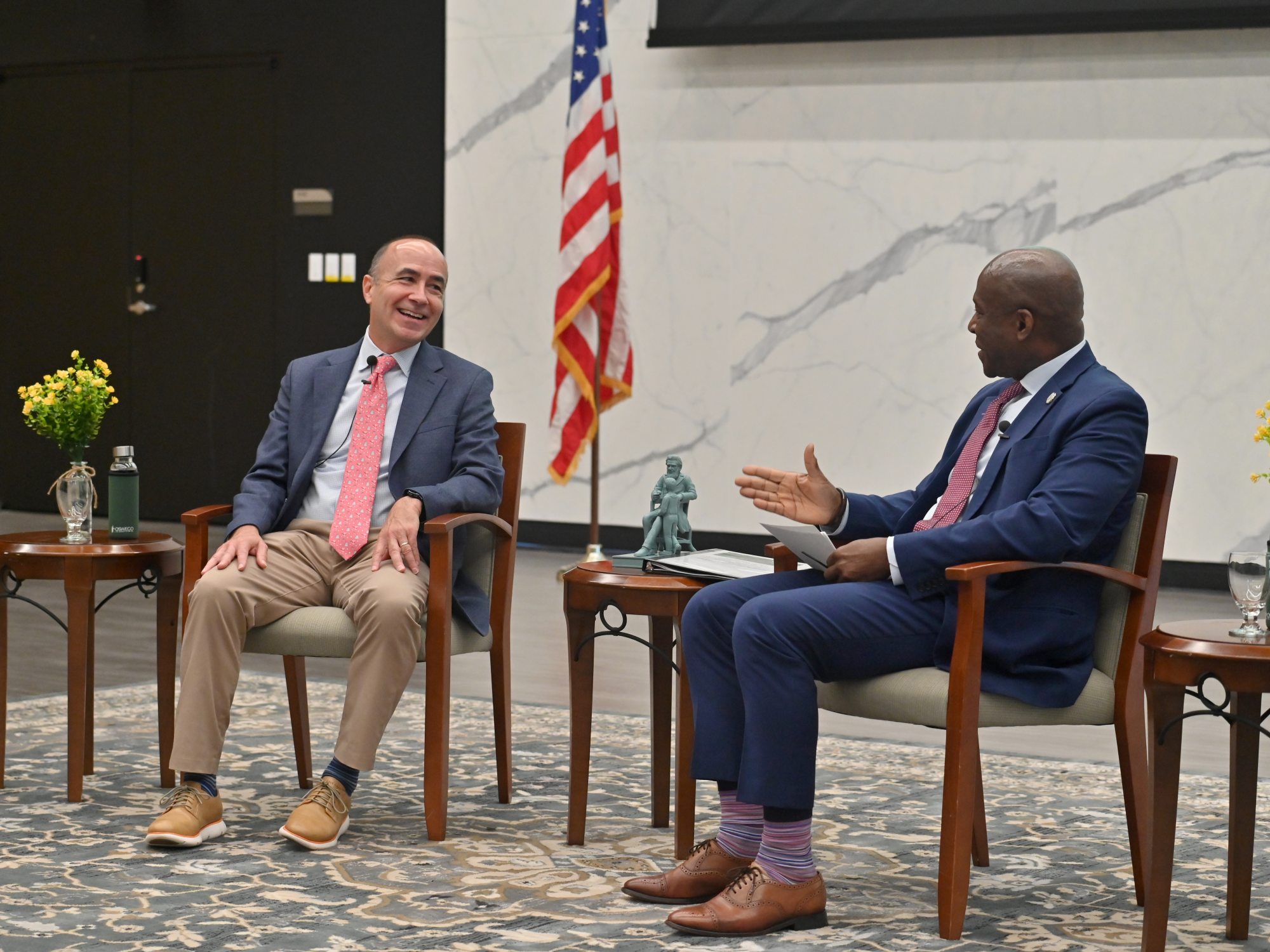
SUNY Oswego graduate John Salamone delivers the university's third annual Sheldon Lecture on Leadership and Service in conversation with President Peter O. Nwosu.
For 1991 SUNY Oswego graduate John Salamone — who delivered the university's third annual Sheldon Lecture on Leadership and Service — leadership begins with a simple commitment: helping people when they need it most.
“To me, [public service] is everything. It is everything,” said Salamone, chief human capital officer for the Chief Administrative Officer of the U.S. House of Representatives, during the lecture in the Hewitt Hall ballroom on Oct. 28.
Throughout a career spanning more than three decades in government and public service, Salamone has worked to improve the systems that help people do their jobs and serve others. Speaking in a conversation with President Peter O. Nwosu before the campus community, he reflected on the experiences that shaped his career, the lessons he carried from Oswego and the advice he hopes students will remember as they begin their own professional journeys.
At the conclusion of the event, President Nwosu presented Salamone with a SUNY Oswego Presidential Medal for Distinguished Leadership and Service. The audience responded with a standing ovation, underscoring the admiration he had earned through his humor, humility and distinguished accomplishments.
“For me, it’s all about helping people when they need it the most,” Salamone said.
That commitment emerged early in his career, when an internship in Sen. Al D’Amato’s office introduced him to the practical side of public service. Salamone found satisfaction in helping constituents navigate federal bureaucracy, whether resolving a problem with a government agency or expediting a passport.
He said he initially expected to teach and coach soccer after college. Instead, the internship opened a door to a career he had not anticipated. After graduating, he accepted a part-time position in the senator’s office before moving to Washington, D.C., in 1993. He later earned a master’s degree in public administration from George Mason University and held positions in the U.S. Office of Personnel Management, the Senate and private-sector consulting before joining the House of Representatives.
Large leadership role
As chief human capital officer (the first to ever hold the position), Salamone leads workforce strategy and human resources initiatives that support approximately 10,000 House members, officers and staff. His responsibilities include career development, employee well-being, recruitment and retention, as well as programs that connect veterans, Gold Star family members and military spouses with opportunities to serve in congressional offices.
During his decade with the House, Salamone has helped develop programs and resources that previously did not exist, including career paths, competency models, performance-management processes and career services for congressional staff.
He recalled one early challenge in the role: improving a performance-management process that had drawn persistent complaints from employees. After a senior leader challenged him to find a solution, Salamone and his team developed and implemented a new process for an 800-person organization in just four months. The work laid the foundation for additional improvements, including clearer job descriptions and career-development opportunities.
For Salamone, the experience illustrated what leadership should accomplish: identify a problem, work with others to solve it and leave an organization stronger than before.
“Making the organization better and leaving it in a really good place for the next generation that wants to take it over, that’s what I want to do,” he said.
Lessons from Laker years
Salamone’s path to Washington began with a chance visit to Oswego. After two years at Monroe Community College, he planned to transfer to another SUNY campus until his aunt encouraged him to visit Oswego. The view of Lake Ontario helped make the decision.
He arrived in fall 1989 as a sociology major and member of the men’s soccer team. The transition challenged him more than he expected. After earning a 3.5 GPA at Monroe, he received a 2.2 during his first semester at Oswego while adjusting to more demanding coursework and balancing academics with daily practices.
There were moments when he considered giving up. Instead, he buckled down, improved his grades and finished his senior year with what he described as his best academic and athletic performance.
“The first semester was really, really challenging, and I think it probably is for a lot of students,” he said. “But it gets better, and it gets easier.”
The experience taught him lessons that continued to serve him throughout his career, including time management, critical thinking and communication. He also credited soccer coach Ken Peterson and sociology professors Shigeo Nohara and Richard Loder with making a lasting impression.
Oswego shaped his personal life, too. He met his wife, 1992 graduate Jeannine Muoio Salamone, an Oswego State Athletics Hall of Fame cross-country runner. They have returned for reunions and other campus events, and they established a scholarship to help support current students.
Their connection to the university, Salamone said, remains a strong bond.
Advice for the next generation
Reflecting on his career, Salamone encouraged students to give themselves room to explore, learn and grow. He cautioned against the pressure to map out an entire professional future before taking a first job.
“Careers are marathons. They are not sprints,” he said.
He also urged students to become colleagues others can rely on, even when they begin in supporting roles. A positive attitude, a willingness to contribute and an understanding of how individual work advances a larger mission can make a lasting difference, he said.
Finally, he encouraged students to resist comparing their progress with others and instead pursue their own interests and strengths with purpose.
“You should pursue those gifts, strengths and interests with passion and with purpose,” he said, urging students not to worry about what others are doing or saying.
As the conversation drew to a close, Salamone reflected on what he remains most grateful for: his wife, the experiences they have shared and the university that brought them together.
Before the lecture, he and Jeannine had spent time meeting students, including their scholarship recipient, walking around campus, revisiting memories of their years as students and even reconnecting with Jeannine’s college roommate, Tracey Donovan Fanning of the Class of 1992 and her husband, Mitch, of Auburn.
“We’re just grateful,” he said. “We’re grateful for it.”