
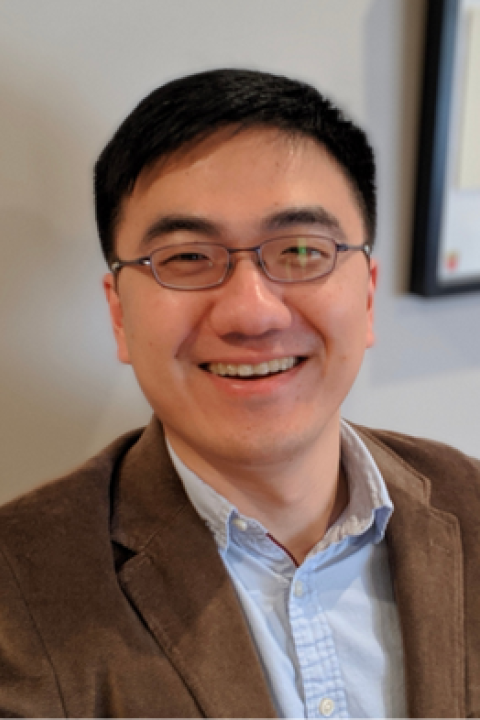
Ting is a Lecturer Professor in the Department of Computer Science at SUNY Oswego. He is a cognitive scientist by training, a data scientist by trade, and a software architect by choice. As a cognitive scientist, he received his PhD in Brain and Cognitive Sciences from the University of Rochester in 2014, specializing in computational models of cognition and language. As a data scientist, he worked in the healthcare and tech industries, applying his expertise to solve complex problems. As a software architect, Ting founded a small SaaS tech nonprofit dedicated to lowering the technical and financial access barriers to conducting online behavioral research.
When he’s not glued to a computer screen, Ting enjoys reading history, woodworking, and growing vegetables in his backyard.
Publications
- Mittman, B., Williams, K., Qian, T., & Bejjanki, V. R. (2023). Learning and Information Use in an Intergroup Context. In Proceedings of the 45th Annual Meeting of the Cognitive Science Society. (pp. 709-716)
- Bankieris, K., Qian, T., & Aslin, R. N. (2019). Synesthetes perseverate in implicit learning: Evidence from a non-stationary statistical learning task. Quarterly Journal of Experimental Psychology, 72(7), 1771-1779.
- Cocos, A., Qian, T., & Masino, A. J. (2017). Crowd Control: Effectively Utilizing Unscreened Crowd Workers for Biomedical Data Annotation. Journal of Biomedical Informatics, 69, 86-92.
- Qian, T., Jaeger, T. F., & Aslin, R. N. (2016). Incremental Implicit Learning of Bundles of Statistical Patterns. Cognition, 157, 156-173.
- Qian, T., & Masino, A. J. (2016). Latent Patient Cluster Discovery for Robust Future Forecasting and New-patient Generalization. PLoS ONE, 11(9): e0162812. oi:10.1371/journal.pone.0162812
- Qian, T. & Aslin, R. N. (2014). Learning bundles of stimuli renders stimulus order as a cue, not a confound. Proceedings of the National Academy of Sciences of the United States of America, 111(40), 14400-14405.
- Fine, A. B., Jaeger, T. F., Farmer T., & Qian, T. (2013). Rapid Expectation Adaptation During Syntactic Comprehension. PLOS One, 8(10):e77661. doi:10.1371/journal.pone.0077661
- Qian, T., & Jaeger, T. F. (2012). Cue Effectiveness in Communicatively Efficient Discourse Production. Cognitive Science, 36, 1312-1336.
Education
- Ph.D. in Brain and Cognitive Sciences, University of Rochester 2009-2014
- B.S. in Brain and Cognitive Sciences, University of Rochester 2007-2009
- Cognitive Science Program, SUNY Oswego 2005-2007